™Log inStart free
    INBDE subjectBasic sciencesFree to read

    INBDE Behavioral Science

    A one-page high-yield review of behavioral science for the INBDE, and 3 practice questions with every answer explained.

    Written from open sources: every line of the review comes from DentPrep's Behavioral Science guide, and every question here ties each claim to a quote from its source and was answered blind by a second AI model. None comes from the live exam.

    See the questions

    No account needed for the test · Free account · No card

    On this page

    What the INBDE tests in Behavioral Science

    The JCNDE doesn't publish a list by subject. It writes the INBDE to its clinical content areas. These are the content areas DentPrep maps most behavioral science questions to:

    1. 15Interact and communicate with patients using psychological, social, and behavioral principles.
    2. 14Understand how patient attributes (e.g., gender, age, race, ethnicity, and special needs), social background and values influence the provision of oral health care at all stages of life.
    3. 52Use prevention, intervention, and patient education strategies to maximize oral health.

    DentPrep's checklist for Behavioral Science has 27 topics:

    • The patient-centered interview
    • Empathy, rapport and nonverbal communication
    • Explaining options and deciding together
    • Health literacy
    • Breaking bad news
    • Difficult conversations
    • Culture, language and bias
    • Communicating with older adults and patients with disabilities
    • Health behavior theories applied to one patient
    • The stages of change
    • Motivational interviewing
    • Learning principles
    • Adherence and preventive counseling
    • Tobacco and nicotine cessation counseling
    • Dental fear, anxiety and phobia
    • Measuring dental anxiety
    • Managing the anxious adult without drugs
    • The psychology of pain
    • Needle fear, fainting and gagging
    • Development across the life span
    • Mental health in the dental chair
    • Substance use: screening and brief intervention
    • Social circumstances and patient attributes
    • Coping, defenses and loss
    • Self-assessment and reflective practice
    • Stress, burnout and wellbeing
    • Clinical reasoning and cognitive bias

    Behavioral Science high-yield review

    The cheat sheet from DentPrep's Behavioral Science notes, as it is in the app. Each line names the guide section it comes from.

    Interviewing

    • Open questions first (how, what, describe), so the patient does most of the talking; closed questions after, for detail. Guide: The patient-centered interview
    • Leading or yes/no questions steer the answer; avoid them when opening. Guide: The patient-centered interview
    • A reflection is a statement of what the patient means; not advice, a question or reassurance. Guide: Reflective listening and summaries
    • A summary gathers what was said and checks it was understood. Guide: Reflective listening and summaries

    Motivational interviewing

    • MI: a collaborative, patient-centered way of guiding that evokes the patient's own motivation and resolves ambivalence. Guide: Motivational interviewing
    • Spirit (fourth edition, 2023): partnership, acceptance, compassion, empowerment (PACE); earlier accounts name evocation. Never confrontation. Guide: Motivational interviewing
    • Processes (tasks in the fourth edition): engaging (rapport), focusing (what to change), evoking (the patient's reasons), planning (the patient's steps); not in a fixed order. Guide: Motivational interviewing
    • Skills, OARS: open questions, affirmations, reflective listening, summaries. Guide: Motivational interviewing
    • Brief MI runs 5 to 20 min; with 15-minute encounters 64% of studies found an effect (Rubak 2005); evidence in periodontal outcomes is mixed. Guide: Motivational interviewing
    • Change talk, DARN-CAT: desire, ability, reasons, need; commitment, activation, taking steps. Sustain talk defends no change. Guide: Change talk and sustain talk
    • Answer change talk with EARS: elaborate, affirm, reflect, summarize; more change talk usually means time to plan. Guide: Change talk and sustain talk
    • Righting (fixing) reflex: the urge to advise and fix too early. Guide: The righting reflex and discord
    • Sustain talk is the patient's case for no change; discord is friction with the clinician (arguing, denying, ignoring, interrupting). Don't argue: reflect. Guide: The righting reflex and discord
    • Ask, offer, ask (elicit-provide-elicit): permission, neutral information, the patient's view. Guide: Ask, offer, ask
    • Rulers: importance and confidence, each a number on a scale. Guide: Change talk and sustain talk

    The stages of change

    • Precontemplation: no intention to act in the foreseeable future. Guide: The stages of change
    • Contemplation: aware, intends to act within 6 months. Guide: The stages of change
    • Preparation: ready to act within 30 days; small steps (floss bought, not yet used). Guide: The stages of change
    • Action: behavior changed, for less than 6 months. Guide: The stages of change
    • Maintenance: sustained 6 months or more; preventing relapse. Guide: The stages of change
    • Not ready: don't persuade; raise awareness with permission. Unsure: explore ambivalence. Ready: the patient's own goals. Guide: The stages of change

    Dental fear

    • Anxiety precedes the encounter; fear reacts to a known threat (fight or flight). Guide: Dental fear, anxiety and phobia
    • Dental phobia (DSM-5): excessive, out-of-proportion fear, typically 6 months or more, with distress or impairment; avoided or endured with intense fear. Guide: Dental fear, anxiety and phobia
    • 5–15% of adults report high or severe dental anxiety or phobia. Guide: Dental fear, anxiety and phobia
    • Learned from a painful past visit (conditioning), anxious family (vicarious), media and lack of understanding. Guide: Dental fear, anxiety and phobia
    • Vicious cycle: avoidance → emergency visit → traumatic treatment → more fear → more avoidance. Guide: Dental fear, anxiety and phobia
    • Anxious patients feel more pain, longer, and remember it as worse. Guide: Dental fear, anxiety and phobia
    • First: a calm conversation, open questions on past care, fears and expectations; refer if part of a wider disorder. Guide: Dental fear, anxiety and phobia
    • MDAS: 5 items, 5 to 25, high anxiety at 19; adds the injection item to Corah's 4. Guide: Measuring dental anxiety
    • Corah's DAS: 4 items, 4 to 20; 13 to 14 high, 15 or more severe. Dental Fear Survey: 20 items, 20 to 100, 60 high. Guide: Measuring dental anxiety

    Managing the anxious adult

    • Tell (explain), show (see, hear, feel it safely), do (exactly as shown); adults too; informational control. Guide: Tell-show-do and modeling
    • Stop signal: agreed before treatment (a raised hand); the dentist stops as agreed, or trust is lost. Guide: The stop signal
    • Progressive muscle relaxation: tense 5 to 7 seconds, relax 20; practiced at home. Guide: Relaxation
    • Don't keep anxious patients waiting; close the door on instrument noise. Guide: Relaxation
    • Systematic desensitization: hierarchy, relaxation, exposure from least to most feared, several sessions. Guide: Systematic desensitization
    • Flooding: prolonged exposure to the feared stimulus; caution, limited evidence. Guide: Systematic desensitization
    • Exposure-based CBT: cognitive restructuring plus graded exposure; the preferred treatment for dental phobia, with lasting effect; psychologists preferred. Guide: Cognitive behavioral therapy
    • Low or moderate anxiety: communication, rapport, control, information. High, no urgent need: CBT. High and urgent: treat under sedation, then CBT. Guide: Cognitive behavioral therapy
    • Sedation: temporary relief; also when a patient can't or won't take part in psychological treatment. Guide: Cognitive behavioral therapy

    Explaining and deciding together

    • Shared decision-making: share the evidence; the patient is supported to consider options and reach informed preferences. Guide: Shared decision-making
    • Three-talk model: team talk (there's a choice, support, the patient's goals), option talk (compare, with risk communication), decision talk ("what matters most to you?"). Guide: Shared decision-making
    • "It's up to you" and stepping back: the patient may feel abandoned. Guide: Shared decision-making
    • Szasz and Hollender: activity-passivity (parent-infant, emergencies), guidance-cooperation (parent-adolescent, acute infections), mutual participation (two adults, equal power). Guide: Models of the dentist-patient relationship
    • Never a relative risk alone ("halves your risk"); give absolute risks: 4 in 100 → 2 in 100. Guide: Communicating risk
    • Several frequencies: all "out of" the same number, not "1 in…". Guide: Communicating risk
    • Framing switches preferences: give both frames (success and failure). Guide: Communicating risk
    • Icon arrays (dots, not faces) or bar charts; uncertainty as a numerical range. Guide: Communicating risk

    Health literacy

    • Personal health literacy: find, understand and use information (Healthy People 2030); organizational: the organization equitably enables it. Guide: Health literacy
    • Low health literacy is often hidden and clinicians underestimate misunderstanding: universal precautions, plain language and teach-back for all. Guide: Health literacy
    • AMA's seven basic techniques: two to three concepts at a time, family or friends, pictures, speak slowly, simple language; repeat back, what you'll do at home. Guide: Health literacy
    • Screening tools: REALM-SF, SAHL, short TOFHLA. Under 25% of US dentists reported using teach-back. Guide: Health literacy
    • Plain language: familiar words, no jargon, short sentences; 2 or 3 messages at a time. Guide: Plain language
    • Handouts: about a 5th or 6th grade reading level, below the adult average of 7th-8th. Guide: Plain language
    • Teach-back: the patient says it in their own words (what will you do at home?); the dentist owns the explanation; not a test. Guide: Teach-back
    • Chunk and check: after each chunk, not at the end; wrong, explain differently and ask again. Not "Do you understand?" alone. Guide: Teach-back

    Hard news and hard conversations

    • SPIKES: Setting, Perception (what do you understand?), Invitation (how much detail?), Knowledge (warning shot, small pieces), Emotions (stop, name, validate), Strategy and summary. Guide: Breaking bad news: SPIKES
    • Warning shot: "I'm afraid the results are not what we hoped." Guide: Breaking bad news: SPIKES
    • ABCDE: Advance preparation, Build a therapeutic environment, Communicate well, Deal with reactions, Encourage emotions. Guide: Breaking bad news: SPIKES
    • NURSE: Name, Understand, Respect, Support, Explore; pause first. Guide: Responding to emotion: NURSE
    • I wish (hope), I worry (counsel), I wonder (a recommendation). Guide: Responding to emotion: NURSE
    • Anger is often grief or suffering; listen without interrupting, name it, calm and firm tone, plan together; limits if behavior crosses a line. Guide: The angry patient and de-escalation
    • Dental malpractice complaints: highly related to communication breakdown, more than technical competence (one review). Guide: The angry patient and de-escalation
    • Error disclosure (HEEAL): say plainly what happened and how, a sincere apology, what will prevent it. Guide: Disclosing an error
    • Personal questions: "What makes you ask me that?" or "This visit is about you, not me." Splitting: one team, one consistent plan. Guide: Boundaries and the "difficult" label

    The interview, empathy and the body

    • Cone: open, then focused open, then closed questions to confirm details. Guide: Asking questions well
    • Avoid why questions (feel judged), multiple, leading (wording suggests the answer) and tag questions ("…isn't it?"). Guide: Asking questions well
    • Agenda: screen for further concerns ("anything else?") before negotiating the agenda; let the patient finish (an average of 18 s before interrupting, one classic study). Guide: Agenda, signposts and summaries
    • Signpost each move; summarize periodically and invite correction. Guide: Agenda, signposts and summaries
    • Biopsychosocial model (Engel, 1977): biological, psychological and social; ask about the person, not just the tooth. Guide: The biopsychosocial view
    • Empathy acknowledges and tries to understand the feeling ("That must be really hard"); sympathy is pity, unwanted by patients; compassion builds on empathy and adds action. Guide: Empathy, not sympathy
    • Nonverbal: open posture, eye contact, calm pace, pauses; eyes level for children; touch only when culturally appropriate. Guide: Nonverbal communication and the mask
    • Masks hide the mouth and lower speech perception; a warmer voice with pauses, and a transparent mask where the mouth must be seen. Guide: Nonverbal communication and the mask

    Culture and language

    • Cultural humility: the patient is the expert; be the student of the patient; continual self-reflection. Guide: Cultural humility and the explanatory model
    • Kleinman's 8 questions: what do you call it, what caused it, why now, what does it do, how severe and how long, what do you fear, what problems, what treatment and results do you hope for. Guide: Cultural humility and the explanatory model
    • LEARN: Listen, Explain, Acknowledge, Recommend, Negotiate (the key step: a plan made in partnership). Guide: The LEARN model
    • Implicit bias: automatic, outside awareness, coexists with egalitarian values; watch for it under time pressure; linked to undertreated pain in Black patients. Mitigation is continuing, not one session. Guide: Implicit bias
    • Interpreters: trained, not a minor or untrained relative (CLAS); huddle first; interpreter at the patient's side; speak to the patient; 1-2 sentences at a time; teach-back; record the ID. Guide: Working with an interpreter

    Patients with different needs

    • Hearing loss: face the patient, let them lip read; clear, normal volume, slow; repeat and rephrase; write it down. ADA (1990): effective communication. Guide: Hearing loss
    • Dementia: brief, concrete, single-step commands ("Open." "Good." "All done."), slowly and calmly; short visits (about 30 min), mornings; caregiver present. Guide: Dementia
    • Autism: sensory over-responsivity, trouble with changes in routine; visual supports, rehearsal, consistent routines, a sensory-adapted environment. Guide: Autism and sensory needs
    • Elderspeak: endearments, "we" for "you", high pitch, tag questions; heard as patronizing; linked to refusal of care. Guide: Elderspeak

    Why patients act, or don't

    TheoryKey constructsWhat the dentist does
    Health belief model (Rosenstock)perceived susceptibility + severity = threat; benefits vs barriers; cues to action; self-efficacyfind the low belief: "not me" (susceptibility), "takes too long" (barrier) Guide: The health belief model
    Social cognitive theory (Bandura)reciprocal determinism (person, behavior, environment); observational learning; self-efficacysmall steps the patient succeeds at; change the setting Guide: Social cognitive theory and self-efficacy
    Theory of planned behavior (Ajzen)attitude + subjective norm + perceived behavioral control → intention → behavior; reasoned action lacks controlwork on the weak belief; lower barriers to control Guide: The theory of planned behavior
    Locus of controlinternal ("up to me") vs external (chance or fate: "just luck"; powerful others: "your job, doctor")show what is in the patient's hands Guide: Locus of control
    Self-determination theoryautonomy, competence, relatednessoffer a choice, practice to success, be on the patient's side Guide: Self-determination theory
    • Education alone: knowledge rises, but temporarily, and outcomes may not change. Guide: Theories, learning and preventive counseling

    How habits and fears are learned

    PrincipleIn the chairUse it, or the trap
    Classical conditioningdrill's sound (neutral → conditioned stimulus) paired with pain (unconditioned) → fear at the soundcounterconditioning: pair the setting with something pleasant Guide: Classical conditioning
    Negative reinforcementremoving something unpleasant: relief after cancelling keeps avoidance alive; an earned restnegative ≠ punishment: the behavior rises Guide: Operant conditioning
    Positive reinforcementspecific praise right after ("Thank you for sitting without moving")after the behavior, never a bribe before it Guide: Operant conditioning
    Negative punishmenta pleasant stimulus removed after the behavior: the parent asked to step out after kicking Guide: Operant conditioning
    Extinction burstreinforcement stops; the behavior briefly rises above its old rategiving in at the peak reinforces it Guide: Reinforcement, extinction and relapse
    Partial reinforcementslower to learn than continuous, but persists longer in extinctionpraise every time early, some of the time later Guide: Reinforcement, extinction and relapse
    Spontaneous recoveryan extinguished fear returns after time has passedthe laboratory model of relapse Guide: Reinforcement, extinction and relapse
    Observational learningfear learned from a parent, sibling or media, with no bad visit of one's ownmodeling: a calm peer or a video Guide: Observational learning and modeling

    Adherence and goals

    • Compliance: matches the prescriber's orders, criticized as passive obedience. Adherence: follows recommendations the patient agreed to. Guide: Adherence
    • Repetition and reinforcement after the first session improve adherence. Guide: Adherence
    • Goal: specific, small, the patient's own. Implementation intention: "If [situation], then I [behavior]": when, where, how. Guide: Goals, if-then plans and self-monitoring
    • Self-monitoring-focused interventions: of value for interdental cleaning, which leans on self-regulation more than brushing. Guide: Goals, if-then plans and self-monitoring
    • Fear appeals (meta-analysis d = 0.29): pair the threat with efficacy (what to do, and that the patient can); low efficacy → fear control, rejection. Guide: Fear appeals

    Tobacco

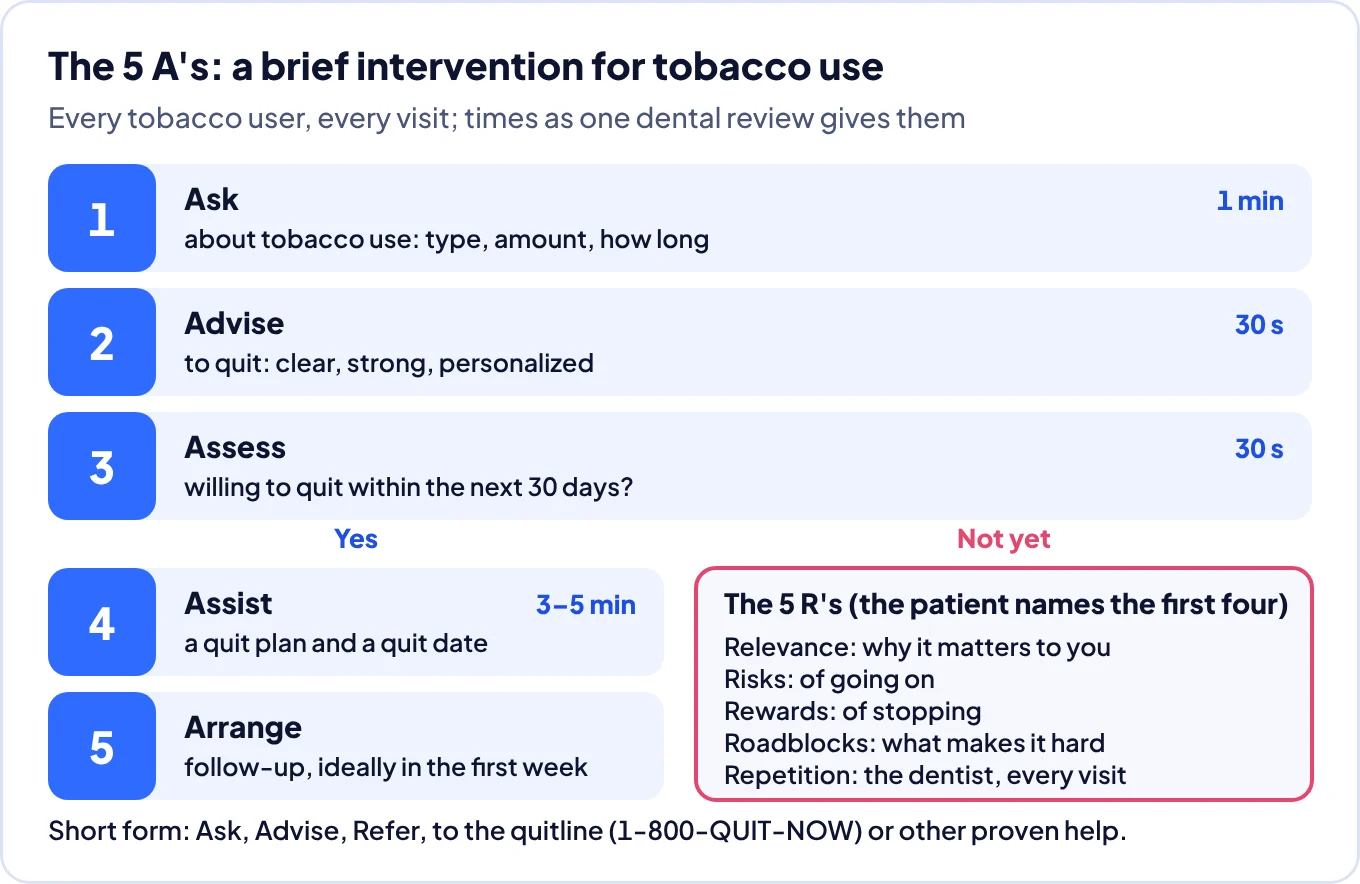
    The 5 A's with their times, and the 5 R's for the patient not ready
    • 5 A's: Ask (1 min), Advise clear, strong, personalized (30 s), Assess: willing within the next 30 days? (30 s), Assist: plan and quit date (3–5 min), Arrange: follow-up, preferably within the first week after the quit date. Guide: The 5 A's
    • Ask all patients, risk factors or not; smoking status as a vital sign at every visit. Guide: The 5 A's
    • A 3 min brief intervention: quit rate up by 30%. Dental professionals' programs: 74 vs 27 of 1000 stopped. Guide: The 5 A's
    • Not ready within 30 days: the 5 R's: Relevance, Risks, Rewards, Roadblocks (the patient names them), Repetition (the dentist, every visit). Guide: The 5 R's
    • Ask, Advise, Refer: for limited time; 1-800-QUIT-NOW, free coaching; quitlines raised quit rates by about 60% (relative) vs minimal or no counseling. Guide: Ask, advise, refer and the quitline
    • FDA-approved: NRT (patch, gum, lozenge, inhaler, nasal spray), bupropion SR, varenicline; short- plus long-acting NRT beats one form; counseling + medication beats either alone. Guide: Medication and withdrawal
    • E-cigarettes for cessation: evidence insufficient; direct to proven treatments. Pregnancy: counseling. Guide: Medication and withdrawal
    • Withdrawal: starts within 24 h, peaks at 3 days, resolves by about 4 weeks. Tobacco dependence is chronic and relapsing; most try several times. Guide: Medication and withdrawal

    Pain, needles and gagging

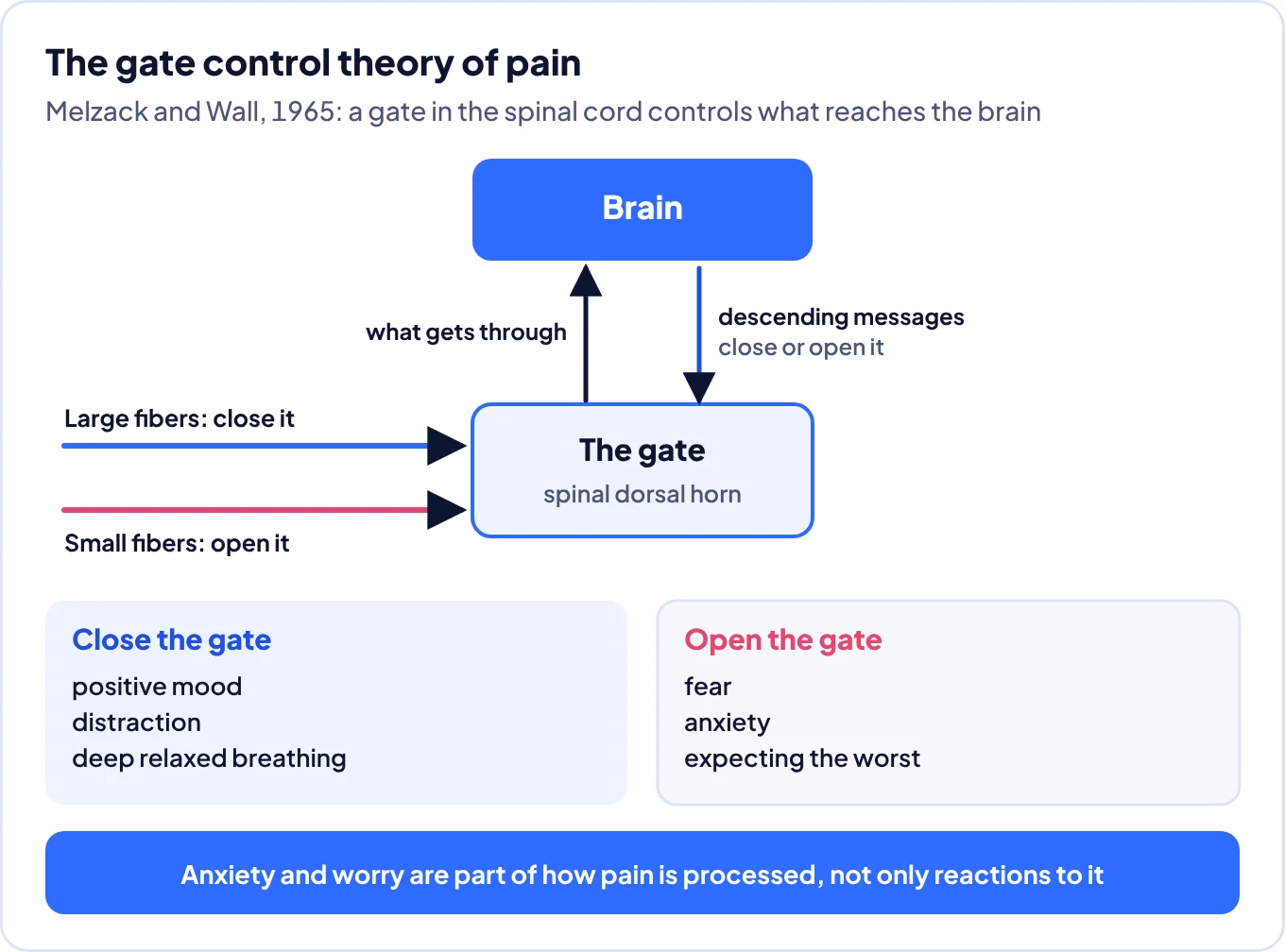
    The gate control theory: large fibers close the gate, small fibers open it, the brain modulates it from above
    • Pain (IASP, 2020): an unpleasant sensory and emotional experience associated with, or resembling that associated with, actual or potential tissue damage; always personal; the report is respected. Guide: What pain is
    • Nociception: the nervous system's activity in response to a noxious stimulus; pain cannot be inferred from it alone. Chronic (ICD-11): more than three months, biopsychosocial. Guide: What pain is
    • Gate control (Melzack and Wall, 1965): large fibers close, small fibers open, descending messages from the brain modulate; distraction and relaxed breathing close it, fear and expecting the worst open it. Guide: The gate control theory
    • Threshold: the minimum stimulation that provokes pain. Tolerance: the maximum a person can endure. Lower tolerance goes with higher dental anxiety. Guide: Anxiety, threshold and tolerance
    • Nocebo: symptoms from negative expectation; "This won't hurt" and repeated "Are you OK?" can keep the patient vigilant; give control instead. Guide: Placebo, nocebo and the words before the needle
    • Catastrophizing: rumination, magnification, helplessness; Pain Catastrophizing Scale 0 to 52. Fear-avoidance: catastrophizing → fear → hypervigilance → avoidance → disuse, depression, more pain. Guide: Catastrophizing and fear-avoidance
    • NRS 0 to 10; VAS a 10 cm line; faces for patients who find numbers or lines hard. Guide: Measuring pain
    • Chronic orofacial pain is amplified by anxiety, depression, sleep disorders, catastrophizing and low self-efficacy. Guide: Chronic orofacial pain
    • Blood-injection-injury fear: sympathetic rise, often then a vasovagal fall → faint; learned by conditioning. Inject slowly; a plastic handpiece or computer-controlled delivery. Guide: Needle fear and fainting
    • Applied tension: alternately tense and release the large muscles to keep the blood pressure from falling; with exposure. Guide: Applied tension
    • Gagging and anxiety feed each other. 4P: preparatory, psychological (salt on the tongue tip, nasal breathing, graded exposure), physical (almost upright), pharmacological (nitrous oxide); aim to reduce its impact. Guide: The gag reflex
    • Guided imagery: relaxation, visualization, positive suggestion. Biofeedback: measure and feed back for self-regulation. Hypnosis: suggestion, an adjunct; CBT stays first for phobia. Guide: Imagery, biofeedback and hypnosis
    • Music: slow (60–80 beats per minute), through headphones, the patient on the volume. VRET: graded exposure in a virtual setting. Short waits. Guide: Music, virtual reality and waiting

    Mental health, substance use, coping and circumstances

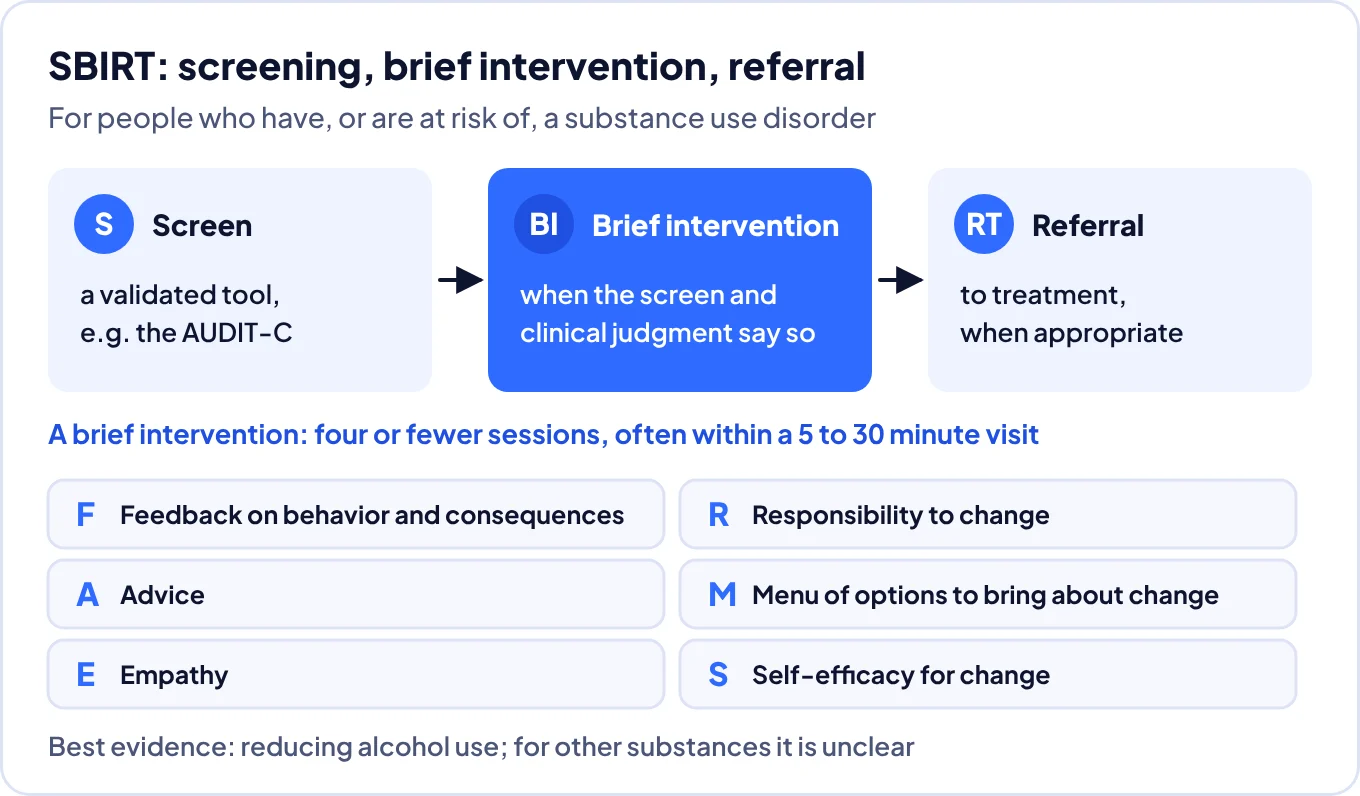
    SBIRT: screen, brief intervention, referral to treatment, with the FRAMES elements
    • Common in practice: anxiety, mood, psychotic and eating disorders. Depression: withdrawn, dry mouth, accelerated caries, candidiasis, burning mouth. Welcome like anyone else; empathy, patience, tact; liaison with the psychiatrist. Guide: Mental illness in the chair
    • PHQ-2: little interest or pleasure; feeling down, depressed or hopeless. GAD-2: nervous, anxious or on edge; can't stop or control worrying. Each 0 to 6; 3 or more = positive screen, not a diagnosis. Guide: Screening for depression and anxiety
    • Suicide: studies suggest 80 to 90% of people who die by suicide increase contact with primary care first. The dental team screens and signposts; it does not diagnose or treat. 988 (since July 2022): call, text or chat, 24/7, free and confidential. Guide: Suicide: asking and signposting
    • Trauma-informed care: a universal precaution, no disclosure needed. Four Rs: realize, recognize, respond, resist re-traumatization. Principles: safety, trustworthiness, choice, collaboration, empowerment. Permission before touch; stop if the patient dissociates. Guide: Trauma-informed care
    • Bulimia: erosion in 78% in one study, most often lingual (palatal) surfaces of the upper front teeth; ask without judgment, refer. BDD: distressing preoccupation with an imagined or slight flaw; unrealistic expectations, usually unsatisfied. Guide: Eating disorders and body image
    • SBIRT: screen (validated tool) → brief intervention (when indicated) → referral to treatment (when appropriate). Brief = four or fewer sessions, often 5 to 30 minutes. FRAMES: Feedback, Responsibility, Advice, Menu, Empathy, Self-efficacy. Best evidence for alcohol. Guide: SBIRT
    • AUDIT (WHO); AUDIT-C = its first three questions, 0 to 4 each (one US program: 3+ women, 4+ men). CAGE: Cut down, Annoyed, Guilty, Eye-opener; positive at 2. Guide: Screening for alcohol
    • Avoid "addict", "abuser", "alcoholic", "clean", "dirty"; "use" or "misuse", not "abuse". Prior substance use disorder: a risk factor for persistent opioid use; opioids not shown better than non-opioids after extraction. Guide: Words, stigma and opioids
    • Defenses: automatic. Immature: denial, rationalization, projection. Neurotic: repression, displacement, intellectualization. Mature: sublimation, suppression (chosen, temporary), humor, anticipation. Guide: Defense mechanisms and coping
    • Kübler-Ross: denial, anger, bargaining, depression, acceptance, a frame not a checklist. Tooth loss (100 patients): 58% struggled to accept it, 37% unprepared; linked to depression, not to denture satisfaction. Guide: Grief and losing teeth
    • Sexual and gender minority: 7.6% of US adults (2023); avoid care from past or expected stigma. Pronouns, inclusive intake forms, neutral words, no assumptions. Guide: Sexual and gender minority patients
    • Homelessness: competing needs, no address, cost, inflexible appointments. Ask the patient's priorities; prompt, often same-day emergency care; flexibility; trusted intermediaries. Guide: Homelessness and access

    The dentist: self-assessment, stress, burnout and bias

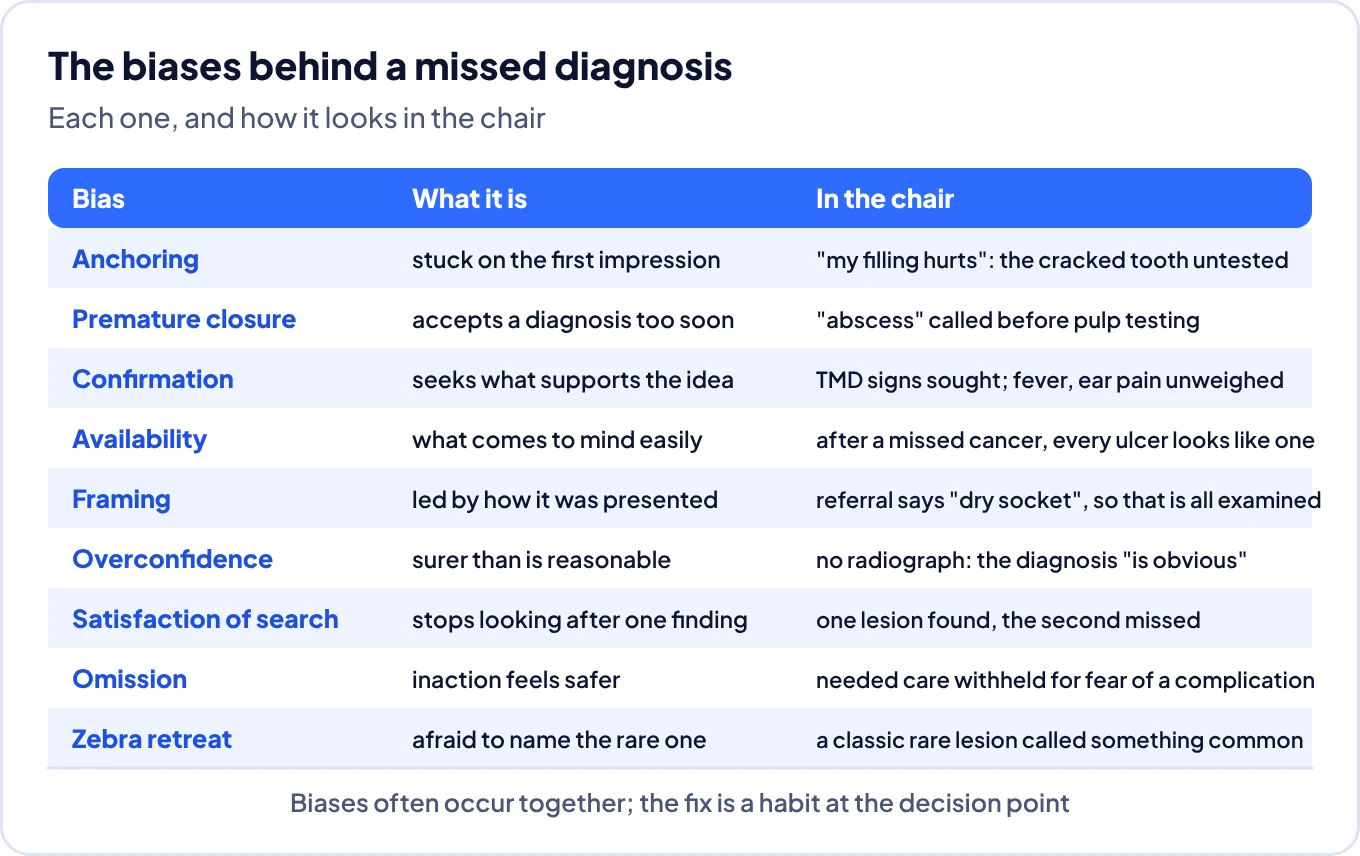
    Cognitive biases a dentist meets, each with its definition and a dental example
    • Self-assessment: one's performance against a standard; often inaccurate. Dunning-Kruger: the weakest overestimate most, the strongest are accurate or underestimate. Calibrate with an outside standard, feedback, video. Guide: Self-assessment and its blind spot
    • Four stages of competence: unconscious incompetence (don't know what you don't know), conscious incompetence, conscious competence (with effort), unconscious competence. Guide: Self-assessment and its blind spot
    • Reflection before, in and on action (Schön); a case reflection: What? So what? Now what? A skill that is taught; with a colleague where possible. Guide: Reflective practice
    • Burnout (chronic workplace stress, occupational, not depression): emotional exhaustion, depersonalization (detachment, cynicism toward patients and work), reduced personal accomplishment. MBI (human services form, MBI-HSS): 22 items; no cut-off diagnosis. Guide: Burnout
    • Dentists, one meta-analysis: 13% overall; 25% high EE, 18% high DP, 32% low PA. Linked: young age, long hours; working alone with low PA. High burnout: odds ratio 4.07 for a self-reported error. Guide: Burnout
    • Perceived stress = the appraisal of demands as taxing. Yerkes-Dodson: inverted U; moderate arousal helps a hard task, high arousal hurts. Acute stress: more errors, slower, worse handling and teamwork. Guide: Stress, arousal and performance
    • Compassion fatigue, in one account: secondary traumatic stress (from empathic exposure to others' trauma) + burnout (chronic workplace stress). Guide: Compassion fatigue and secondary traumatic stress
    • Wellbeing: the person (stress management, coping, mindfulness, counseling) and the workplace (assistants, not alone, hours, ergonomics); program evidence very low certainty; no substitute for organization-level prevention. Guide: Coping, wellbeing and getting help
    • Clinicians' substance use: similar to or slightly above the public's; risk from access, invincibility, stress; most noticed by colleagues, not self-referred. Health programs: typically confidential, an alternative to discipline, 5-year monitoring; 80.7% completed. Duties (urge, report first-hand) are ethics'. Guide: Substance use and the impaired clinician
    • System 1: fast, intuitive, routine, heuristics. System 2: slow, deliberate. Most biases thought to come from System 1 overused or overriding System 2; many diagnostic errors are errors of thinking, not knowledge. Guide: Fast and slow thinking
    • Anchoring: stuck on the first impression. Premature closure: accepts a diagnosis too soon. Confirmation: seeks support. Availability: easy to recall. Framing: how it was presented. Satisfaction of search: stops after the first finding. Omission: inaction feels safer. Zebra retreat: afraid to name the rare one. Guide: The biases behind a missed diagnosis
    • Debiasing: what else could it be; a second search; a first look at the image before the history; the base rate, weighed with the findings; checklists and a team that speaks; slow down; feedback on outcomes; match workload to staffing. Group consensus can breed conformity. Guide: Debiasing

    DentPrep · INBDE Behavioral Science cheat sheet · dentprep.me/inbde

    Practice behavioral science the exam's way.

    Your free account opens 100 INBDE questions with every option explained, and every subject's notes and cheat sheet.

    Start freeFree account · No card

    3 practice questions

    Three questions from the behavioral science bank, each with its answer, why every other option is wrong, and its sources.

    Question 1 of 3

    Patient

    Female, 29 years old

    Chief Complaint

    “My gums bleed when I brush.”

    Background and/or Patient History

    Dental

    Has never flossed

    Social

    Bought floss yesterday

    Plans to floss nightly from Monday

    Which stage of change is she in?

    1. AContemplation
    2. BMaintenance
    3. CPreparation
    4. DAction
    Show the answer

    Answer CPreparation

    Preparation is readiness to act within the next 30 days, often with small steps already taken, such as buying a toothbrush or floss before starting to use it.

    Why the others are wrong

    • AContemplation is awareness of a problem with an intention to act within the next 6 months; she plans to start within days and has taken a step.
    • BMaintenance is a change sustained for at least 6 months.
    • DAction is a behavior that has already changed, for less than 6 months; she has not started flossing.

    The rule: the stages of change (the transtheoretical model, Prochaska and DiClemente) view "behavior change as a process, rather than a single outcome" (Chan et al., 2023).

    Stage Definition (Chan et al., 2023)
    Precontemplation "no intention to act in the foreseeable future"
    Contemplation "an intention to act within the next 6 months"
    Preparation "a readiness to act within the next 30 days"
    Action "a changed behavior observed for less than 6 months"
    Maintenance "the adopted behavior has been sustained for at least 6 months"

    Chan et al.'s own example of preparation is "buying a toothbrush without having started brushing"; in preparation people "may begin taking small steps toward behavior change" (Akman et al., 2026).

    Applied to the question: floss bought (a small step), a start date days away, no flossing yet: preparation. The stage calls for building on her commitment and helping her set "feasible steps/goals" (Gillam and Yusuf, 2019).

    Trap: calling her "in action" because she has done something. Action means the behavior itself has changed; buying floss is a step toward it.

    The point to rememberPreparation = ready to act within 30 days, small steps taken; action = the behavior has changed, under 6 months.

    Sources (3)
    1. Chan CCK, Chan AKY, Chu CH, Tsang YC. Theory-based behavioral change interventions to improve periodontal health. Front Oral Health. 2023;4:1067092, Stages of change and transtheoretical model
    2. Akman AO, Kalayci F, Karakus S, Özaydın E, Tas D. The transtheoretical model and smoking cessation: findings from a youth-friendly clinic. BMC Public Health. 2026;26:1810, Transtheoretical model
    3. Gillam DG, Yusuf H. Brief motivational interviewing in dental practice. Dent J (Basel). 2019;7:51, Readiness to change
    Question 2 of 3

    The patient understands the options for an endodontically treated tooth. In decision talk, which question from the dentist best fits the three-talk model?

    1. A"Would you like me to just choose the best one for you?"
    2. B"Tell me what matters most to you for this decision."
    3. C"Which of these would most dentists choose, do you think?"
    4. D"Can you sign here so that we can book the first visit?"
    Show the answer

    Answer B"Tell me what matters most to you for this decision."

    Decision talk is the task of arriving at a decision that reflects the patient's informed preferences, guided by the clinician's experience. The model's own suggested words are 'Tell me what matters most to you for this decision.'

    Why the others are wrong

    • AOffering to choose for the patient returns to 'doctor knows best' and skips the patient's preferences.
    • CWhat other dentists would choose is not the patient's preference; it moves the decision away from the patient.
    • DSigning comes after a decision; this skips the decision itself.

    The rule (Elwyn et al., 2017): "Decision talk refers to the task of arriving at decisions that reflect the informed preferences of patients, guided by the experience and expertise of health professionals." The authors added the phrase "Tell me what matters most to you for this decision" for it.

    Talk Its task (Elwyn et al., 2017) Words
    Team talk "indicate choice", "provide support", "identify goals" "Let's work as a team to make a decision that suits you best."
    Option talk "comparing alternatives, using risk communication principles" what each option means, out of 100
    Decision talk "decisions that reflect the informed preferences of patients" "Tell me what matters most to you for this decision."

    Applied to the patient: the options are understood, so option talk is done. Asking what matters most (keeping the tooth, cost, time, the risk of another procedure) turns understanding into a preference the dentist can help weigh.

    Trap: going back to the numbers. Information alone does not make the decision; the patient's priorities do, with the dentist's guidance.

    The point to rememberDecision talk: "Tell me what matters most to you for this decision."

    Sources (1)
    1. Elwyn G, Durand MA, Song J, et al. A three-talk model for shared decision making: multistage consultation process. BMJ. 2017;359:j4891, Results

    Question 3 of 3

    A hygienist praised every correct flossing attempt while the skill was new. Now that the child flosses well, which praise schedule will best make the behavior persist once praise stops?

    1. APraise some of the time (partial reinforcement)
    2. BPraise only when the child asks for it
    3. CStop all praise at once
    4. DPraise every time (continuous reinforcement)
    Show the answer

    Answer APraise some of the time (partial reinforcement)

    Partial reinforcement produces slower learning than continuous reinforcement but greater persistence during extinction: the partial reinforcement extinction effect. Continuous praise suits the start; partial praise keeps the habit.

    Why the others are wrong

    • BPraise only on request reinforces asking, not flossing.
    • CStopping all reinforcement is extinction itself.
    • DContinuous reinforcement learns fastest but extinguishes faster when the reinforcement stops.

    The rule (Hulsbosch et al., 2026): "In general, partial reinforcement produces slower learning compared to continuous reinforcement but leads to greater behavioral persistence during extinction (i.e., Partial Reinforcement Extinction Effect (PREE)". In their children, "partial reinforcement and stretching the ratios resulted in more behavioral persistence compared to continuous reinforcement".

    Schedule Learning When reinforcement stops
    continuous (every time) fast fades sooner
    partial (some of the time) slower persists longer

    Applied to the patient: praise every success while the habit forms, then praise some of the time, so the habit lasts between visits when no one is watching.

    Trap: thinking more reinforcement always gives a stronger habit. Continuous reinforcement is best for learning, not for lasting.

    The point to rememberPartial reinforcement: slower to learn, but it resists extinction.

    Sources (1)
    1. Hulsbosch AK, Beckers T, Furukawa E, et al. Behavioral and emotional responding during instrumental learning in children with ADHD: reinforcement schedule effects. J Atten Disord. 2026 (PMC13620386), Introduction; Results

    Take the free 20-question test →

    What the full guide covers

    The Behavioral Science guide runs to about 25,000 words in 7 parts:

    1. The conversation in the chair
    2. Explaining, deciding together and hard conversations
    3. Rapport, culture and patients with different needs
    4. Theories, learning and preventive counseling
    5. Pain, needles and gagging
    6. Mental health, substance use, coping and circumstances
    7. The dentist: self-assessment, stress, burnout and bias

    The full notes and their PDF are free on a DentPrep account, beside the question bank.

    More INBDE subjects

    Basic sciences

    All 23 subjects →

    Free on your account

    100 INBDE questions, free.

    Every option explained, and every note, cheat sheet and PDF. Your free account never ends.

    One plan for all of it: $49 a month, $129 for three months, or $349 a year.

    Start freeFree account · No cardSee pricing
    What else your free account opens
    • Interviews5 scored answers, 1 mock interview with its report, and 2 Casper scenarios
    • TOEFLAll 20 lessons, one practice set of each Reading and Listening task, and 2 scored speaking or writing tasks
    • Application reviewYour first statement or resume review: the verdict, the summary, the strengths and the 2 most serious suggestions
    • Dental schoolFree: your lectures, summaries, questions and flashcards, 10 drafts and 10 summaries a day
    • School guidesAll 113, no account needed
    20 INBDE questions, free.Take the test