™Log inStart free
    INBDE subjectClinical dentistryFree to read

    INBDE Oral Medicine

    A one-page high-yield review of oral medicine for the INBDE, and 3 practice questions with every answer explained.

    Written from open sources: every line of the review comes from DentPrep's Oral Medicine guide, and every question here ties each claim to a quote from its source and was answered blind by a second AI model. None comes from the live exam.

    See the questions

    No account needed for the test · Free account · No card

    On this page

    What the INBDE tests in Oral Medicine

    The JCNDE doesn't publish a list by subject. It writes the INBDE to its clinical content areas. These are the content areas DentPrep maps most oral medicine questions to:

    1. 23Prevent, diagnose and manage oral mucosal and osseous diseases.
    2. 8Recognize the manifestations of systemic disease and how the disease and its management may affect the delivery of dental care.
    3. 10Select the diagnostic tools most likely to establish or confirm the diagnosis.

    DentPrep's checklist for Oral Medicine has 28 topics:

    • The oral medicine history and examination
    • Tests and referral
    • The suspicious lesion and the potentially malignant disorder
    • Corticosteroids for mucosal disease
    • Recurrent aphthous stomatitis
    • Herpes simplex
    • Zoster and other viral infections
    • Oral candidiasis
    • Oral lichen planus and lichenoid lesions
    • Immune blistering disease
    • Erythema multiforme, SJS/TEN and drug reactions
    • Other mucosal conditions in practice
    • Xerostomia and salivary hypofunction
    • Managing dry mouth
    • Sjögren disease
    • Sialorrhea and salivary swelling
    • Approach to orofacial pain
    • Trigeminal neuralgia
    • Burning mouth syndrome
    • Neuropathic and persistent pain after dental treatment
    • Pain from elsewhere
    • Taste, smell, the facial nerve and other sensory complaints
    • Blood and nutritional disease
    • Endocrine and metabolic disease
    • Gastrointestinal, liver and kidney disease
    • Immune and rheumatologic disease
    • Oral complications of cancer therapy
    • Osteoradionecrosis

    Oral Medicine high-yield review

    The cheat sheet from DentPrep's Oral Medicine notes, as it is in the app. Each line names the guide section it comes from.

    Evaluating the patient

    • History of an ulcer: number, size, duration, frequency, age of onset, lesions elsewhere; drugs, HIV status, the review of systems. Guide: The history
    • Two weeks or longer is chronic; recurrent ulcers heal between episodes; a single chronic ulcer: rule out squamous cell carcinoma first. Guide: The history
    • Ask every adult about tobacco and alcohol; no risk factor is no reassurance. Guide: The history
    • Clinical oral examination at every new patient, recall and emergency visit: white light and palpation, extraoral and intraoral, neck nodes felt. Guide: The examination and the record
    • Record site, size, color, margins and duration; a photograph that shows the surroundings goes with every referral. Guide: The examination and the record
    • Diascopy: a slide pressed on it; vascular blanches, pigment keeps its color. Guide: The examination and the record

    Tests and referral

    You suspectThe testSpecimen or step
    dysplasia or cancerincisional biopsy; avoid excising itno anesthetic into the lesion Guide: Choosing the test
    pemphigus or pemphigoiddirect immunofluorescenceperilesional tissue, Michel's medium Guide: Choosing the test
    candidiasisPAS or silver smear, or cultureSabouraud's agar Guide: Choosing the test
    active herpesPCR, viral culture, Tzanck smearserology if no active lesion Guide: Choosing the test
    a systemic cause of aphthaeblood count, ferritin, B12, folate, inflammatory markerswhen worse, after 25, or with general symptoms Guide: Choosing the test
    • Celiac suspected: IgA autoantibody serology, then the gastroenterologist; cyclic neutropenia: serial blood counts over several weeks. Guide: Choosing the test
    • Possible malignancy: oral and maxillofacial surgeon, oral pathologist, oral medicine or head and neck surgeon; send the description, history and photographs. Guide: Referral: to whom and how fast
    • Palatal ulcer or necrosis, sinus pain, eye swelling or double vision in uncontrolled diabetes: mucormycosis, the same day. Guide: Referral: to whom and how fast
    • A neck mass that persists or grows: investigate. Guide: Referral: to whom and how fast

    The suspicious lesion

    • Abnormality not resolving beyond 10 to 14 days without a definitive diagnosis or plan: biopsy or refer. Guide: The suspicious lesion: the 2026 ADA pathway
    • Cytology, toluidine blue, light-based tests: against, to decide or to screen; salivary tests: research only. Guide: The suspicious lesion: the 2026 ADA pathway
    • Biopsy not possible: cytology; positive or atypical reinforces biopsy; negative, review in 10 to 14 days, and a lesion that persists is biopsied. Guide: The suspicious lesion: the 2026 ADA pathway
    • Leukoplakia: non-homogeneous worse than homogeneous; erythroplakia very high risk; risk rises with the dysplasia grade. Guide: Leukoplakia, erythroplakia and dysplasia
    • Stop tobacco and alcohol; excise moderate and severe dysplasia; 70 to 90% respond, 25 to 30% recur. Guide: Leukoplakia, erythroplakia and dysplasia
    • After an oral cancer: about 20% develop a second primary; a field can take 67 to 96 months; the whole mouth and neck, for life. Guide: After an oral cancer: field cancerization

    Topical corticosteroids

    • First line for aphthae and sore lichen planus: triamcinolone 0.1% paste, fluocinonide 0.05% gel, clobetasol 0.05% gel (superpotent), dexamethasone 0.5 mg/5 mL rinse. Guide: Topical corticosteroids
    • Paste: a small dab pressed on, not rubbed in; at bedtime, and after meals; not healed in seven days → investigate. Guide: Topical corticosteroids
    • Lowest potency that works; trays for the gingiva; clobetasol and fluocinonide gels are skin products, so oral use is off-label. Guide: Topical corticosteroids
    • Watch for candidiasis (the commonest effect) and, with potent steroids over large areas or under occlusion, adrenal suppression. Guide: Topical corticosteroids
    • Never on a fungal, viral or bacterial infection of the mouth. Guide: Topical corticosteroids

    Aphthae

    • Minor about 80%, heal in 10–14 days; major larger than 1 cm, up to 6 weeks, scar; herpetiform up to 100 ulcers. Guide: Recurrent aphthous stomatitis
    • Nonkeratinized mucosa; recurrent intraoral herpes favors the keratinized hard palate. Guide: Recurrent aphthous stomatitis
    • Topical steroid first; chlorhexidine or tetracycline rinse, 2% viscous lidocaine, a protective coating. Guide: Recurrent aphthous stomatitis
    • Labs when attacks worsen, start after 25, or come with general symptoms: blood count, ferritin, B12, folate; celiac serology if suspected. Guide: Recurrent aphthous stomatitis
    • Systemic drugs (colchicine, prednisone, dapsone) only for severe disease, after systemic and infectious causes are excluded. Guide: Recurrent aphthous stomatitis

    Herpes simplex

    • Primary herpes: age six months to 5 years, fever, fiery gingiva, many ulcers; heals in 10–14 days. Guide: Primary herpetic gingivostomatitis
    • Fluids and pain relief; acyclovir only within 72 hours, for substantial pain or dehydration; dehydration is the commonest complication. Guide: Primary herpetic gingivostomatitis
    • Cold sore at the tingle: valacyclovir 2 g twice, 12 hours apart, 1 day; or famciclovir 1500 mg once. Guide: Recurrent herpes labialis
    • Penciclovir 1% every 2 hours while awake for 4 days; docosanol 10% five times a day (over the counter). Guide: Recurrent herpes labialis
    • No shown benefit once a papule, vesicle or ulcer is present. Guide: Recurrent herpes labialis
    • Active lesion: defer elective dental care; prophylaxis for frequent recurrences after dental visits. Guide: Recurrent herpes labialis

    Candidiasis

    • Clinical, supported by a KOH smear or culture; biopsy a hyperplastic plaque. Guide: Oral candidiasis
    • Mild: clotrimazole 10 mg troche five times a day for 14 days; nystatin 4 to 6 mL four times daily, held then swallowed; miconazole 50 mg buccal tablet once daily. Guide: Oral candidiasis
    • Moderate to severe, or topical failure: fluconazole 200 mg day 1, then 100 mg daily, at least 2 weeks. Guide: Oral candidiasis
    • Fluconazole and miconazole raise the INR on warfarin; fluconazole and QT drugs. Guide: Oral candidiasis
    • Never nystatin with chlorhexidine; never swallow nystatin tablets whole; rinse after an inhaled steroid. Guide: Oral candidiasis
    • Denture stomatitis: denture out at night, cleaned, disinfected (acrylic: 0.5% hypochlorite, 10 min at most; never metal), plus an antifungal. Guide: Denture stomatitis and angular cheilitis
    • Angular cheilitis: clotrimazole or miconazole on the lips, and treat the source inside the mouth. Guide: Denture stomatitis and angular cheilitis

    Lichen planus and lichenoid lesions

    • Biopsy to confirm; painless reticular disease: no drug, follow-up. Guide: Oral lichen planus
    • Sore disease: topical steroid (clobetasol, fluocinonide, triamcinolone paste), stepped down to the lowest that controls it; treat candidiasis; healed erosions with residual striae is the endpoint. Guide: Oral lichen planus
    • Transformation: 1.43% for lichen planus, 5.13% with dysplasia; higher in smokers, on the tongue, with hepatitis C. Guide: Oral lichen planus
    • One-sided, touching an amalgam: replace that restoration (biopsy first if it looks atypical); patch testing not routine. Guide: Lichenoid contact and drug reactions

    Pemphigus and pemphigoid

    • Pemphigus: oral lesions in about 90%, the first sign in more than 50%; intraepithelial split; IgG on keratinocyte surfaces. Guide: Pemphigus vulgaris and mucous membrane pemphigoid
    • Pemphigoid: desquamative gingivitis, blood blisters, women over 50; subepithelial split; linear deposits along the basement membrane zone. Guide: Pemphigus vulgaris and mucous membrane pemphigoid
    • Immunofluorescence biopsy: intact mucosa beside the lesion, in Michel's medium. Guide: Pemphigus vulgaris and mucous membrane pemphigoid
    • Pemphigus: systemic treatment by the specialist (moderate to severe: prednisolone 1 mg/kg/day with rituximab); topical steroid only as an adjunct. Guide: Pemphigus vulgaris and mucous membrane pemphigoid
    • Pemphigoid: topical steroid if mild and confined to the mouth; every patient's eyes examined; regular professional plaque removal. Guide: Pemphigus vulgaris and mucous membrane pemphigoid

    Zoster, HIV and the chronic infections

    • Zoster: pain (it can mimic toothache), then one-sided vesicles stopping at the midline; PCR only if ambiguous. Guide: Herpes zoster in the face
    • Acyclovir 800 mg 5 times a day for 7 to 10 days; valacyclovir 1 g three times a day for 7 days; famciclovir 500 mg every 8 hours for 7 days; start at once. Guide: Herpes zoster in the face
    • Tip of the nose (Hutchinson's sign): the eye; ear vesicles with facial palsy: Ramsay Hunt; weeks later, dead alveolar bone and lost teeth in that division. Guide: Herpes zoster in the face
    • HIV: oral lesions in up to 50%, up to 80% with CD4 under 200; thrush the commonest. Guide: The oral lesions of HIV
    • Hairy leukoplakia: EBV, lateral tongue, does not wipe off; no treatment; can be the first sign of HIV. Guide: The oral lesions of HIV
    • Kaposi sarcoma: HHV-8, hard palate, red then purple nodules; biopsy and refer. Warts: HPV 6 and 11. Guide: The oral lesions of HIV
    • Any HIV-marking lesion with no known cause of immunosuppression: offer an HIV test. Guide: The oral lesions of HIV
    • Chancre: single, painless, indurated, about three weeks after exposure, painless node; secondary: mucous patches, snail-track ulcers; tertiary: gumma. Guide: Syphilis
    • Syphilis serology: a nontreponemal (RPR, VDRL) plus a treponemal test; one alone is not enough; penicillin G 2.4 million units IM is the physician's. Guide: Syphilis
    • Tuberculous ulcer: caseating granulomas support but do not prove it; mycobacterial culture, a chest radiograph, then the physician. Guide: Oral tuberculosis

    Reactions in the mouth

    • Erythema multiforme: 10–14 days after herpes; bloody crusted lips, targets; supportive; recurrent: continuous acyclovir, 200–800 mg/day for 26 weeks. Guide: Erythema multiforme and Mycoplasma-induced mucositis
    • Mycoplasma mucositis: two or more mucosae, few skin lesions, a cough; antibiotics; the eyes early. Guide: Erythema multiforme and Mycoplasma-induced mucositis
    • SJS/TEN: 4 days to 4 weeks after a new drug; under 10% SJS, 10 to 30% overlap, over 30% TEN; stop every probable drug, hospital now, the eyes early. Guide: Stevens-Johnson syndrome and toxic epidermal necrolysis
    • Fixed drug eruption: the same site after the same drug (acetaminophen, NSAIDs); avoid the drug; healed in 15 to 21 days. Guide: Fixed drug eruption
    • Angioedema without hives: ask about drugs first, ACE inhibitors above all; stop it, and no ACE inhibitor again after ACE inhibitor angioedema; tongue or throat: the emergency department; antihistamines do not help bradykinin swelling. Guide: Angioedema

    Pigment and look-alikes

    • Pigment: blanches = vascular; metal on the film = amalgam tattoo; diffuse palate with antimalarials, minocycline or imatinib = benign drug pigment, often persists. Guide: Pigment in the mouth: drugs, amalgam and melanoma
    • Solitary and unexplained, or irregular, growing, multifocal or raised pigment, above all on the hard palate or maxillary gingiva: biopsy now; 5-year survival as low as 15%. Guide: Pigment in the mouth: drugs, amalgam and melanoma
    • Sun-ray striae or a palatal lichenoid lesion: lupus; lichenoid lace after an allogeneic transplant: graft-versus-host disease; both followed as potentially malignant. Guide: Lupus and graft-versus-host disease: lichen planus look-alikes
    • A lupus flare: anti-dsDNA often up, C3 and C4 often both low, used up by immune complexes through the classical pathway; low C3 with normal C4 points to the alternative pathway. Guide: Lupus and graft-versus-host disease: lichen planus look-alikes
    • Plasma cell gingivitis: an allergen (toothpaste, gum, cinnamon, mint); blood count and biopsy; kappa and lambda both. Guide: Plasma cell gingivitis
    • White sponge nevus, nicotine stomatitis, tori: recognize and leave alone. Guide: Findings to recognize and leave alone

    Dry mouth

    • Xerostomia is the complaint; hyposalivation is measured: unstimulated ≤0.1 mL/min (normal 0.3–0.4), stimulated ≤0.5–0.7 (normal 1.5–2.0). Guide: Xerostomia and salivary hypofunction
    • Collect for at least 5 minutes, after an overnight fast or 2 hours after a meal; paraffin 1–2 g for stimulated flow. Guide: Xerostomia and salivary hypofunction
    • Causes: drugs first, then head and neck radiation and Sjögren disease; in older patients look at the drug list, not the age. Guide: Xerostomia and salivary hypofunction
    • Signs: a sticking mirror, frothy saliva, no pool in the floor of the mouth, a glassy palate, cervical caries on more than two teeth. Guide: Xerostomia and salivary hypofunction
    • Steps: the physician for the drugs; water, night humidity, sugar-free gum; saliva substitutes; a sialogogue only if the glands still work. Guide: Managing a dry mouth
    • Teeth: high-concentration, pH-neutral fluoride daily; 1.1% NaF gel once daily, at least one minute at bedtime, nothing for 30 minutes; xylitol, not sugar. Guide: Managing a dry mouth
    • Malic acid spray relieves but can erode enamel; candidiasis watched for. Guide: Managing a dry mouth

    Sialogogues

    • Pilocarpine: 5 mg three times a day after radiation (up to 30 mg a day, 10 mg a dose, judged at 12 weeks); 5 mg four times a day in Sjögren. Guide: Sialogogues: pilocarpine and cevimeline
    • Cevimeline: 30 mg three times a day, Sjögren only; CYP2D6 and 3A4 inhibitors raise it. Guide: Sialogogues: pilocarpine and cevimeline
    • Not in uncontrolled asthma, acute iritis or narrow-angle glaucoma; care with COPD, heart disease, beta-blockers. Guide: Sialogogues: pilocarpine and cevimeline
    • Sweating is the commonest effect (43% in the Sjögren trials) and the commonest reason to stop; blurred vision at night. Guide: Sialogogues: pilocarpine and cevimeline

    Sjögren disease

    • 2016 ACR/EULAR: labial biopsy focus score ≥1 = 3; anti-SSA = 3; ocular staining ≥5, Schirmer ≤5 mm in 5 minutes, unstimulated flow ≤0.1 mL/min = 1 each; ≥4 classifies. Guide: Sjögren disease
    • Anti-SSB alone scores nothing; exclude head and neck radiation, hepatitis C, AIDS, sarcoidosis, amyloidosis, GVHD, IgG4 disease. Guide: Sjögren disease
    • Systemic in at least 70%; B-cell lymphoma 5–10% lifetime: a new gland swelling is investigated early; low C4 the strongest predictor. Guide: Sjögren disease
    • Mouth: substitutes, gum, fluoride, xylitol; pilocarpine with residual function; no routine systemic steroids. Guide: Sjögren disease

    Salivary swelling and drooling

    • Acute bacterial sialadenitis: one gland, pus at the duct, S. aureus; fluids, massage toward the duct, a beta-lactamase-resistant antibiotic 7–10 days by culture. Guide: Acute bacterial sialadenitis
    • No sialography while acute. Juvenile recurrent parotitis: ages 3 to 6, boys, settles by puberty. Guide: Acute bacterial sialadenitis
    • Stones: more than 80% submandibular; pain and swelling at meals; palpate back to front; ultrasound finds most over 2 mm. Guide: Salivary stones
    • Small, accessible stone: rehydration, warm moist heat, massage; antibiotic if infected; surgery if that fails. Guide: Salivary stones
    • Sialadenosis: both parotids, soft, painless; diabetes, alcohol, bulimia, malnutrition. Guide: Sialadenosis and the salivary mass
    • Tumors: parotid 20–25% malignant, submandibular 40%, sublingual more than 90%; refer urgently with palsy, pain, fixation, fast growth or nodes. Guide: Sialadenosis and the salivary mass
    • Drooling: cerebral palsy, Parkinson disease, ALS, clozapine; poor swallowing, not excess saliva; glycopyrrolate (ages 3 to 16) or botulinum toxin. Guide: Drooling (sialorrhea)

    Orofacial pain: the approach

    • Most orofacial pain is the teeth: prove or exclude them with tests that reproduce the familiar pain. Guide: The approach to orofacial pain
    • ICOP groups: 1 teeth, 2 muscles, 3 joint, 4 cranial nerves, 5 like the primary headaches, 6 idiopathic (6.1 BMS, 6.2 facial, 6.3 dentoalveolar). Guide: The approach to orofacial pain
    • Worse with jaw use, better with rest: TMD (sole cause in 8% of "odontogenic" pain); the commonest non-dental pain after root canal treatment. Guide: The approach to orofacial pain
    • Altered sensation beside the pain points to a nerve; percussion tells them apart poorly; apical tenderness points to the tooth. Guide: The approach to orofacial pain
    • Red flags go urgently: a mass or nodes, weight loss or fever, numbness or weakness, sudden loss of a sense, pain on coughing, new jaw pain on a bisphosphonate. Guide: The approach to orofacial pain
    • Over 50, a new headache, jaw claudication after 2 to 3 minutes of chewing, tender temporal arteries: giant cell arteritis, to the physician at once; glucocorticoids not delayed for the biopsy. Guide: Giant cell arteritis
    • Its biopsy: non-necrotizing granulomatous panarteritis, T cells and macrophages, sometimes giant cells; IL-6 drives CRP (raised in 90.1%); tocilizumab blocks the IL-6 receptor. Guide: Giant cell arteritis

    Trigeminal and glossopharyngeal neuralgia

    • Shocks under a second to 2 minutes, one side, V2 and V3 most (V1 in a quarter), women 3:2, onset 53 to 57. Guide: Trigeminal neuralgia
    • Triggered by light touch in 91–99%: shaving, brushing, talking, chewing; a refractory period after an attack; pain-free between. Guide: Trigeminal neuralgia
    • Classical about 75%, secondary about 15% (tumor, malformation, MS), idiopathic about 10%: MRI for everyone. Guide: Trigeminal neuralgia
    • A sensory deficit or both sides affected: assume a secondary cause. Guide: Trigeminal neuralgia
    • Carbamazepine or oxcarbazepine first (control in almost 90%; up to 40% stop for side effects); no opioids; microvascular decompression for refractory classical disease. Guide: Trigeminal neuralgia
    • Carbamazepine: 100 mg twice a day, up to 200 mg a day more as needed, 400 to 800 mg usual, 1,200 mg the ceiling; reduce every 3 months. Guide: Carbamazepine and oxcarbazepine
    • Before it: blood counts; HLA-B*1502 in at-risk Asian ancestry, Han Chinese above all. Erythromycin, clarithromycin and the azoles raise its level. Guide: Carbamazepine and oxcarbazepine
    • Glossopharyngeal: throat, tonsil, tongue base and ear, set off by swallowing; carbamazepine. Guide: Glossopharyngeal neuralgia

    Burning mouth syndrome

    • Daily, more than 2 hours a day, more than 3 months, no lesion; women 50 to 70, 5 to 1. Guide: Burning mouth syndrome
    • Anterior tongue, both sides, low on waking and at meals; taste change in two-thirds; mucosa and flow normal. Guide: Burning mouth syndrome
    • Rule out candidiasis, deficiencies (iron, B12, folate, zinc), diabetes, thyroid disease, a dry mouth, ACE inhibitors, paroxetine, habits. Guide: Burning mouth syndrome
    • Explain and reassure; topical clonazepam spat out after 3 minutes; CBT; capsaicin; about 3% resolve in 5 years, about 30% improve. Guide: Burning mouth syndrome

    Pain after dental treatment

    • Post-traumatic neuropathic pain: a known injury, more than 3 months, burning, continuous, sleep spared, sensation always changed. Guide: Post-traumatic trigeminal neuropathic pain
    • Rare; after root canal treatment, apicoectomy, implants, extractions, injections, trauma; inferior alveolar nerve 60%, lingual 28%, third molars 48%. Guide: Post-traumatic trigeminal neuropathic pain
    • Risk: longer pain before treatment, repeated treatments, women, another pain condition; refer early, no more dentistry; tricyclics and gabapentinoids. Guide: Post-traumatic trigeminal neuropathic pain
    • Dentoalveolar pain with nothing found: 80–90% women, upper molars; treating teeth makes it worse; a tricyclic. Guide: Persistent idiopathic dentoalveolar pain
    • A local anesthetic block relieves it for 15–120 minutes: no proof of a dental cause. Guide: Persistent idiopathic dentoalveolar pain
    • Postherpetic neuralgia: pain at least 3 months after zoster, V1 in over 75%; gabapentinoids, tricyclics, topical lidocaine; vaccination prevents it. Guide: Postherpetic neuralgia

    Taste, breath, bite and the facial nerve

    • Hypogeusia less, ageusia none, dysgeusia distorted, phantogeusia without a stimulus; drugs cause 9%–22%, sometimes months or years after starting. Guide: Taste disorders
    • Check the saliva and zinc (Japan's cutoff: under 60 μg/dL deficient); replace zinc when low; stopping the drug can take months to help. Guide: Taste disorders
    • Halitosis: 85% from the mouth (tongue coating, periodontal disease): tongue cleaning and periodontal care; extraoral: the physician; no one else smells it: explain; a fear that persists (halitophobia): a psychologist. Guide: Halitosis
    • Phantom bite: a "wrong" bite with nothing found, about 75% after dental work; explain, refer; no irreversible dental treatment for the sensation. Guide: Occlusal dysesthesia (phantom bite)
    • Whole side of the face, forehead included: Bell palsy, corticosteroids and eye protection; forehead spared: a central lesion, the emergency department. Guide: Bell palsy and the facial nerve
    • Bell palsy: most recover, often within 3 weeks, some over up to 9 months; up to 30% are left with weakness; re-evaluate at 3 months for a tumor. Guide: Bell palsy and the facial nerve

    The mouth as a sign of the body

    The mouth showsThink ofWhat the dentist does
    Sore, smooth red tongue, or a normal-looking tongue that hurtsB12, folate or iron deficiency; 64.3% of B12-deficient patients with oral signs had a normal countB12, folate and iron tests, B12 even with a normal count; numbness means B12 Guide: Blood and nutritional deficiencies
    Bleeding gums, poor healing, perifollicular hemorrhage, bruisesscurvy (vitamin C)the physician; diet Guide: Blood and nutritional deficiencies
    Enlarged bleeding gingiva, pallor, bruises, necrosisacute leukemia (AML in 72.72% of reported cases)urgent blood count, hematologist; no deep cleaning first Guide: Leukemia, low platelets and neutropenia
    Gums ooze on their own, petechiae on the soft palateplatelets under 20,000/µLpressure, topical thrombin or tranexamic acid; keep soft brushing Guide: Leukemia, low platelets and neutropenia
    Scarring ulcers every few weeks, 10 to 14 days each, periodontal losscyclic neutropeniaserial neutrophil counts Guide: Leukemia, low platelets and neutropenia
    Dry mouth, halitosis, candidiasis, fast periodontitisdiabetes; hyposalivation 84% when uncontrolled; A1C over 9%, worse periodontitistreat the periodontitis; it worsens glucose control Guide: Diabetes
    Big tongue, thick lips, late eruptionhypothyroidism (hyperthyroid: early eruption)undiagnosed: postpone elective care, refer Guide: Thyroid and adrenal disease
    New brown buccal patches with general symptomsAddison disease (pigment in 92%)the physician Guide: Thyroid and adrenal disease
    Swollen fissured lips, cobblestones, linear sulcus ulcersCrohn disease (oral lesions 20 to 50%)biopsy and refer Guide: The gut, liver and kidney
    Yellow pustules in a snail trackulcerative colitis, activethe physician Guide: The gut, liver and kidney
    Symmetrical enamel hypoplasia, ulcers, no bowel symptomsceliac diseaseceliac testing Guide: The gut, liver and kidney
    Palatal erosion of the upper front teethreflux (erosion in up to 44%)find the cause; protect the teeth Guide: The gut, liver and kidney
    Pallor, ammonia breath, wipe-off plaques on the ventral tonguekidney failure, uremic stomatitisthe nephrologist; heals as the urea falls Guide: The gut, liver and kidney
    Thin cortices, giant cell lesions, mobile teethrenal osteodystrophythe physician Guide: The gut, liver and kidney
    Petechiae, gingival bleeding, big parotidsliver disease (coagulopathy)bleeding plan before surgery Guide: The gut, liver and kidney

    Mucositis prevention

    • Bolus 5-fluorouracil: 30 minutes of ice chips during the infusion; high-dose melphalan transplant: ice too. Guide: Oral mucositis
    • Head and neck radiation: intraoral photobiomodulation; benzydamine under 50 Gy (suggested with chemotherapy); honey suggested. Guide: Oral mucositis
    • Pain in head and neck chemoradiation: 0.2% morphine mouthwash; magic mouthwash has little evidence. Guide: Oral mucositis
    • Not to prevent it: chlorhexidine in head and neck radiation; sucralfate. Guide: Oral mucositis
    • Checkpoint inhibitors: dry mouth, taste change, lichenoid reactions. Guide: Oral mucositis

    Osteoradionecrosis

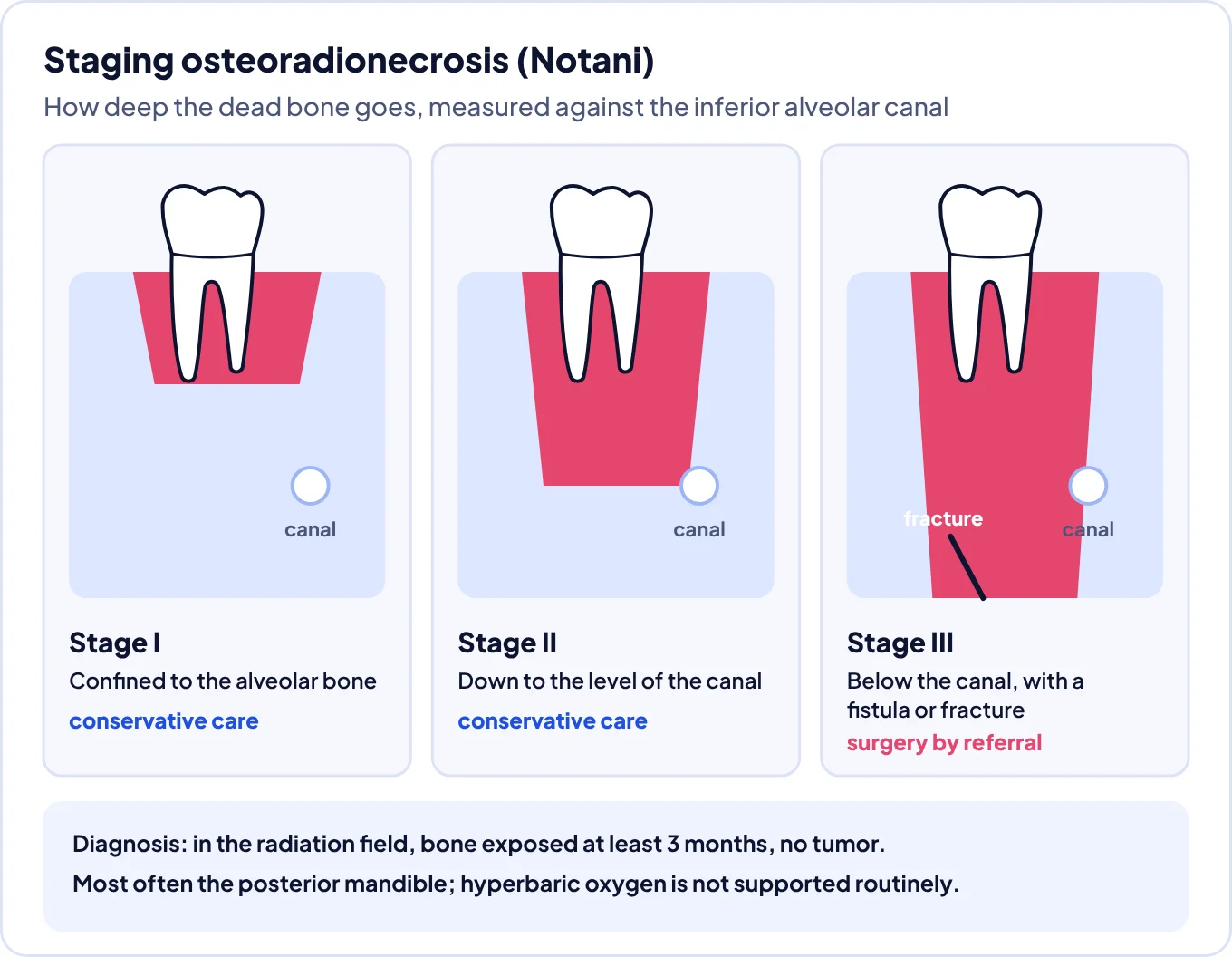
    Notani's stages of osteoradionecrosis: I confined to the alveolar bone, II down to the inferior alveolar canal, III below it with a fistula or fracture
    • Definition: in the radiation field, bone exposed at least 3 months, no tumor; the posterior mandible most. Guide: Osteoradionecrosis
    • 4 to 8% today; over 25% with poor hygiene or extraction after radiation; extraction above 60 Gy the major risk; above 70 Gy it can start alone. Guide: Osteoradionecrosis
    • Notani I and II: hygiene, saline and chlorhexidine, antibiotics if infected, smooth sharp edges; III: resection, fibula flap. Guide: Osteoradionecrosis
    • Pentoxifylline 400 mg twice a day with tocopherol 1,000 IU; hyperbaric oxygen not supported routinely. Guide: Osteoradionecrosis

    Cancer therapy, from before to after

    WhenWhat the mouth doesWhat the dentist does
    Before radiation—extract hopeless teeth in the field atraumatically, primary closure, 10 to 14 days before it starts Guide: Osteoradionecrosis
    Chemotherapy, each cyclefirst signs day 3 to 4, ulcers week two, worst days 7 to 14, heals the week after it stopssoft brush, bland rinses, soft food; ice chips for bolus 5-FU Guide: Oral mucositis
    Radiation, weeks 2 to 7erythema in weeks 2 to 3, ulcers as the dose builds, can last 2 to 4 weeks aftergrade it (WHO III: liquids only); benzydamine under 50 Gy; laser Guide: Oral mucositis
    At the white-cell nadirherpes reactivates; candidiasis in 31%culture herpes, acyclovir or valacyclovir; fluconazole 200 mg then 100 mg daily Guide: Infection during cancer therapy
    After radiationtaste changed in over 75%; trismus under 35 mm, up to 2 years later; caries at the gumline and cusp tipsjaw exercises during radiation; fluoride daily in trays while dry Guide: After radiation: taste, trismus and caries
    Years afterosteoradionecrosis, median 12 to 24 months, most in the first 3 yearsprevent extraction; stage it; conservative care first Guide: Osteoradionecrosis
    • MRONJ is not osteoradionecrosis: it follows a bone-modifying or antiangiogenic drug in a patient never irradiated to the head and neck. Guide: Osteoradionecrosis

    DentPrep · INBDE Oral Medicine cheat sheet · dentprep.me/inbde

    Practice oral medicine the exam's way.

    Your free account opens 100 INBDE questions with every option explained, and every subject's notes and cheat sheet.

    Start freeFree account · No card

    3 practice questions

    Three questions from the oral medicine bank, each with its answer, why every other option is wrong, and its sources.

    Question 1 of 3

    In the 2020 International Classification of Orofacial Pain, which group contains burning mouth syndrome?

    1. AIdiopathic orofacial pain
    2. BPain from lesions or disease of the cranial nerves
    3. CMyofascial orofacial pain
    4. DOrofacial pains resembling primary headaches
    Show the answer

    Answer AIdiopathic orofacial pain

    The ICOP has six first-digit groups; the sixth, idiopathic orofacial pain, holds burning mouth syndrome (6.1), persistent idiopathic facial pain (6.2), persistent idiopathic dentoalveolar pain (6.3) and constant unilateral facial pain with additional attacks (6.4).

    Why the others are wrong

    • BGroup 4 holds the neuralgias and the neuropathies with a lesion of a cranial nerve, such as post-traumatic and postherpetic pain.
    • CGroup 2 holds pain from the muscles.
    • DGroup 5 holds orofacial migraine, tension-type, trigeminal autonomic and neurovascular orofacial pain.

    The rule: the ICOP (2020) sorts orofacial pain into six groups.

    ICOP group What it holds
    1 teeth and related structures
    2 myofascial orofacial pain
    3 temporomandibular joint pain
    4 lesion or disease of the cranial nerves
    5 pains resembling the primary headaches: orofacial migraine, tension-type, trigeminal autonomic and neurovascular orofacial pain
    6 idiopathic: 6.1 burning mouth syndrome, 6.2 persistent idiopathic facial pain, 6.3 persistent idiopathic dentoalveolar pain, 6.4 constant unilateral facial pain with additional attacks

    Burning mouth syndrome is defined by what is absent: intraoral burning or dysesthesia daily for more than 2 hours a day over more than 3 months, with no identifiable causative lesion. That is why it sits with the idiopathic pains.

    Applied to the question: group 6, idiopathic orofacial pain, entry 6.1.

    Trap: placing it in group 1 because it is felt in the mouth. A burning mouth with a cause in the mucosa (candidiasis, lichen planus) is a group 1 problem and, by definition, not burning mouth syndrome.

    The point to rememberICOP group 6, idiopathic: 6.1 burning mouth, 6.2 facial pain, 6.3 dentoalveolar pain, 6.4 CUFPA.

    Sources (2)
    1. Development and validation of the International Classification for Orofacial Pain Algorithm. Pain. 2026 (PMC12709632), Introduction; Table 1
    2. A systematic review of treatment for patients with burning mouth syndrome. Cephalalgia. 2022 (PMC8793318), Introduction
    Question 2 of 3

    Which daily pattern is typical of burning mouth syndrome?

    1. ABrief electric shocks set off by eating, nothing between
    2. BOne side of the tongue only, in the lingual nerve's territory
    3. CMinimal on waking and at meals, present most of the day, sleep spared
    4. DOnly in the first hour after waking
    Show the answer

    Answer CMinimal on waking and at meals, present most of the day, sleep spared

    The burning is usually bilateral and symmetrical, present every day for most of the day; it is minimal or even absent early in the morning and during mealtimes, and it seldom interferes with sleep.

    Why the others are wrong

    • ABrief shocks set off by touch or eating are trigeminal neuralgia.
    • BIt is usually bilateral and symmetrical; one-sided burning in a nerve's territory suggests a nerve lesion.
    • DIt is minimal early in the morning, not confined to it, and it lasts most of the day.

    The rule (Feller 2017's description): "The burning sensation of BMS is moderate to severe in intensity, is usually bilaterally symmetrical, and is present every day for most of the day. It is minimal or even absent early in the morning and during mealtimes and it seldom interferes with sleep." The course over the day varies between patients; sparing of sleep and relief at meals are the most consistent parts.

    Feature Burning mouth syndrome
    Site anterior tongue, then the lips, sometimes the palate
    Side both, symmetrical
    Over the day often low on waking and at meals, there most of the day
    Sleep seldom disturbed
    With it taste change in about two-thirds; dryness, yet flow is normal

    Applied to the question: low at the start of the day and at meals, present for most of it.

    Trap: expecting it to wake the patient, or to sit on one side. It seldom disturbs sleep and is usually symmetrical; burning on one side in a nerve's territory points to a nerve lesion.

    The point to rememberBurning mouth: both sides, most of the day, often eased on waking and at meals, sleep seldom disturbed.

    Sources (1)
    1. Feller L, Fourie J, Bouckaert M, et al. Burning mouth syndrome: aetiopathogenesis and principles of management. Pain Res Manag. 2017:1926269 (PMC5664327), Introduction

    Question 3 of 3

    Patient

    Female, 70 years old

    Chief Complaint

    “The roof of my mouth is sore.”

    Background and/or Patient History

    Dental

    Upper complete denture

    No improvement after a first course of topical antifungal

    Current Findings

    Palatal mucosa: red and sore

    The dentist wants laboratory confirmation of Candida before changing treatment. Which test provides it?

    1. ABlood count with ferritin, B12 and folate
    2. BPunch biopsy for direct immunofluorescence
    3. CPeriodic acid-Schiff smear or culture on Sabouraud's agar
    4. DBrush cytology read for dysplasia
    Show the answer

    Answer CPeriodic acid-Schiff smear or culture on Sabouraud's agar

    Candidiasis can be confirmed in the laboratory by a smear from the affected area stained with periodic acid-Schiff or Gomori methenamine silver, or by culture on Sabouraud's agar (Lu 2021).

    Why the others are wrong

    • ABlood tests look for deficiencies that favor candidiasis; they do not show the fungus.
    • BDirect immunofluorescence looks for the antibodies of a blistering disease.
    • DCytology for dysplasia does not confirm a fungal infection.

    The rule (Lu 2021): "Diagnosis can be confirmed with microbiology examination either by staining a smear from the affected area with periodic acid-Schiff (PAS) stain or Gomori methenamine silver (GMS) stain or by culturing a swab from an oral rinse using Sabouraud's agar." Most candidiasis is diagnosed clinically and treated; the laboratory confirms it when the picture is uncertain or treatment has failed.

    You suspect The test The specimen
    dysplasia or cancer incisional biopsy formalin
    pemphigus, pemphigoid direct immunofluorescence perilesional tissue, Michel's medium
    candidiasis PAS or silver smear, or culture swab or oral rinse, Sabouraud's agar
    active herpes PCR, viral culture, Tzanck smear swab of the lesion
    systemic cause of aphthae blood count, ferritin, B12, folate, inflammatory markers blood

    Applied to the patient: a palate that has not responded is smeared or cultured, which also lets the laboratory identify the species when a resistant one is suspected.

    Trap: a biopsy first. A tissue specimen is for the hyperplastic plaque that does not wipe off; a red denture-bearing palate needs a smear or culture.

    The point to rememberCandida: a PAS or silver-stained smear, or culture on Sabouraud's agar, when the picture is unclear or treatment fails.

    Sources (1)
    1. Lu SY. Oral candidosis: pathophysiology and best practice for diagnosis, classification, and successful management. J Fungi. 2021;7:555 (PMC8306613), Diagnosis

    Take the free 20-question test →

    What the full guide covers

    The Oral Medicine guide runs to about 19,000 words in 7 parts:

    1. Evaluating the patient and the suspicious lesion
    2. Managing common mucosal disease
    3. Other mucosal conditions and drug reactions
    4. Dry mouth, Sjögren disease and other salivary complaints
    5. Orofacial pain outside TMD
    6. Taste, smell and other sensory complaints
    7. The systemic patient and cancer therapy

    The full notes and their PDF are free on a DentPrep account, beside the question bank.

    More INBDE subjects

    Clinical dentistry

    All 23 subjects →

    Free on your account

    100 INBDE questions, free.

    Every option explained, and every note, cheat sheet and PDF. Your free account never ends.

    One plan for all of it: $49 a month, $129 for three months, or $349 a year.

    Start freeFree account · No cardSee pricing
    What else your free account opens
    • Interviews5 scored answers, 1 mock interview with its report, and 2 Casper scenarios
    • TOEFLAll 20 lessons, one practice set of each Reading and Listening task, and 2 scored speaking or writing tasks
    • Application reviewYour first statement or resume review: the verdict, the summary, the strengths and the 2 most serious suggestions
    • Dental schoolFree: your lectures, summaries, questions and flashcards, 10 drafts and 10 summaries a day
    • School guidesAll 113, no account needed
    20 INBDE questions, free.Take the test