™Log inStart free
    INBDE subjectPractice and professionFree to read

    INBDE Infection Control and Practice Management

    A one-page high-yield review of infection control and practice management for the INBDE, and 3 practice questions with every answer explained.

    Written from open sources: every line of the review comes from DentPrep's Infection Control and Practice Management guide, and every question here ties each claim to a quote from its source and was answered blind by a second AI model. None comes from the live exam.

    See the questions

    No account needed for the test · Free account · No card

    On this page

    What the INBDE tests in Infection Control and Practice Management

    The JCNDE doesn't publish a list by subject. It writes the INBDE to its clinical content areas. These are the content areas DentPrep maps most infection control and practice management questions to:

    1. 51Adhere to standard precautions for infection control for all clinical procedures.
    2. 47Conduct practice related business activities and financial operations in accordance with sound business practices and jurisprudence (e.g., OSHA and HIPAA).
    3. 46Maintain patient records in accordance with jurisprudence and ethical requirements.

    DentPrep's checklist for Infection Control and Practice Management has 34 topics:

    • Standard and transmission-based precautions
    • Hand hygiene
    • Personal protective equipment
    • Bloodborne pathogens and immunization
    • After an occupational exposure
    • Sharps safety
    • Instrument processing
    • Monitoring sterilization
    • Environmental surfaces
    • Dental unit waterlines
    • Respiratory infections and aerosols
    • Devices attached to the unit and single-use items
    • Laboratory and radiographic asepsis
    • Waste
    • Health of the dental team
    • Safe injection practices
    • The infection prevention program
    • OSHA in the dental office
    • Who regulates what
    • The dental record
    • HIPAA
    • Risk management
    • Dental benefits
    • Practice finances
    • Personnel and employment
    • Allied dental personnel
    • Emergency and disaster preparedness
    • Quality and patient safety
    • Technology and emerging trends
    • Drugs in the office
    • Occupational hazards
    • Scheduling, recall and the front office
    • Practice ownership and arrangements
    • Fire, facility and security

    Infection Control and Practice Management high-yield review

    The cheat sheet from DentPrep's Infection Control and Practice Management notes, as it is in the app. Each line names the guide section it comes from.

    Precautions

    • The CDC's dental guideline's five links: pathogen, reservoir, mode, portal of entry, susceptible host (its epidemiology course adds a portal of exit); break any one. Guide: The chain of infection and how microbes travel
    • Four routes: direct contact, indirect contact (objects), droplets and spatter (a short distance), airborne (suspended for long). Guide: The chain of infection and how microbes travel
    • Standard precautions: every patient; blood, every body fluid but sweat, nonintact skin, mucosa; saliva in dentistry is OPIM. Guide: Standard precautions
    • Universal (OSHA's term) and standard precautions work the same in dentistry. Guide: Standard precautions
    Added on topForWhat you wear or do
    Contactdirect or indirect contact spreadgown and gloves; dedicated or disposable equipment Guide: Transmission-based precautions
    Dropletpertussis, influenza, meningococcusa mask on the patient and on the staff Guide: Transmission-based precautions
    AirborneTB, measles, chickenpox, disseminated zosterpatient masked, an isolation room, a fit-tested N95 (chickenpox and zoster add contact); elective dental care waits Guide: Transmission-based precautions

    Hands

    MethodAgentMinimum
    Routine handwashplain soap and water15 seconds Guide: Methods and how long
    Antiseptic handwashantimicrobial soap and water15 seconds Guide: Methods and how long
    Hand rub60%–95% alcohol, not on soiled handsuntil dry Guide: Methods and how long
    Surgical antisepsisantimicrobial soap; or soap, then a persistent surgical rub2–6 minutes with the soap; the rub as its maker directs; before sterile gloves Guide: Methods and how long
    • When: before and after each patient, before gloves, right after gloves, when soiled, after bare-handed contact with contaminated objects. Guide: When to clean your hands
    • Visibly soiled: soap and water; otherwise an alcohol rub. Guide: When to clean your hands
    • Short, smooth nails; artificial nails usually not recommended; no jewelry that hinders gloves; petroleum lotions only at day's end. Guide: Nails, jewelry and lotions

    Injections

    • One needle, one syringe, one patient; never one syringe for two patients, even with a new needle. Guide: Safe injection practices
    • Every vial entry: a new needle and new syringe, the septum wiped with alcohol first. Guide: Safe injection practices
    • Single-dose vials when possible; leftovers never pooled. Guide: Safe injection practices
    • Multidose vial: one patient's when possible; if shared, out of the operatory; dated when opened, discarded within 28 days. Guide: Safe injection practices
    • Anesthetic cartridge and needle: one patient; the cartridge syringe cleaned and heat-sterilized. Guide: Safe injection practices

    Waste

    • Regulated: dripping, saturated, or caked and able to release blood or OPIM; sharps; tissue; 1%–2% of a dental office's waste. Guide: Regulated and ordinary waste
    • Lightly soiled gauze, gloves, masks, barriers: ordinary trash. Guide: Regulated and ordinary waste
    • Suctioned fluids: poured into a sanitary sewer drain where allowed, in PPE; never down a drain that bypasses an amalgam separator. Guide: Regulated and ordinary waste
    • Sharps container: closable, puncture resistant, leakproof, labeled; upright, near, never overfilled. Guide: Sharps containers and extracted teeth
    • Extracted teeth: regulated waste; returned to the patient on request; with amalgam, never incinerated or heat-sterilized. Guide: Sharps containers and extracted teeth
    • Amalgam separator at least 95%; repaired or replaced within 10 business days; records three years. Guide: Amalgam waste and separators
    • No waste amalgam to the sewer; no oxidizing or acidic line cleaners (bleach, chlorine, iodine, peroxide) with a pH below 6 or above 8. Guide: Amalgam waste and separators

    The team's health

    ConditionRestrictionUntil
    Herpetic whitlowno patient contactlesions heal Guide: Work restrictions
    Conjunctivitisno patient contactdischarge ceases Guide: Work restrictions
    Weeping dermatitisno direct patient care or equipmentit resolves Guide: Work restrictions
    Active TBoff workproved noninfectious Guide: Work restrictions
    Chickenpoxoff worklesions dry and crust Guide: Work restrictions
    Group A strepno patient care24 hours after adequate treatment starts Guide: Work restrictions
    • Restriction policies written, say who decides, and don't penalize reporting with lost wages, benefits or job status. Guide: Work restrictions
    • HBsAg-positive dentist doing routine dentistry: no restriction; exposure-prone surgery under an expert panel, HBV DNA below 1,000 IU/mL. Guide: The infected provider

    Glove reactions

    ReactionCauseOnset
    Irritantnot allergic: soaps, chemicals, glovesdry, irritated skin; common Guide: Glove reactions and latex allergy
    Type IVglove chemicals (latex, nitrile, neoprene), methacrylatesa rash hours later Guide: Glove reactions and latex allergy
    Type I (latex)latex proteins on glove powderminutes; hives to anaphylaxis Guide: Glove reactions and latex allergy
    • Latex allergy: a latex-safe room, every latex product removed; first appointment of the day. Guide: Glove reactions and latex allergy

    PPE

    • Gloves: one pair, one patient; hand hygiene before and after; never washed for reuse (wicking). Guide: Gloves
    • Sterile surgeon's gloves for surgery (biopsy, periodontal, apical, implant, surgical extractions); utility gloves for cleaning, reused only while intact. Guide: Gloves
    • Mask plus eyewear with solid side shields, or a face shield, for any spray; change a wet mask; eyewear for the patient too. Guide: Masks, eyewear and respirators
    • Airborne disease (TB): a fit-tested NIOSH N95 respirator, not a surgical mask. Guide: Masks, eyewear and respirators
    • On: gown, mask, eyewear, gloves. Off: gloves, eyewear, gown, mask; then hand hygiene. Guide: Protective clothing, and putting PPE on and taking it off
    • PPE off before leaving the work area; the employer provides and launders it at no cost. Guide: Protective clothing, and putting PPE on and taking it off

    Bloodborne viruses and vaccines

    • One needlestick, infected source, worker not immune: HBV up to 62% serologic (HBeAg-positive), HIV about 0.23%, HCV about 0.2%. Guide: The three bloodborne viruses
    • HIV after a mucous membrane exposure about 0.09%; HBV survives on dry surfaces at least 1 week. Guide: The three bloodborne viruses
    • Hepatitis B vaccine offered free within 10 working days; a decliner signs and may accept later. Guide: Hepatitis B vaccination and the anti-HBs test
    • Anti-HBs 1 to 2 months after the series: 10 mIU/mL or more = responder, no boosters. Guide: Hepatitis B vaccination and the anti-HBs test
    • Under 10: second series, retest; still under 10: test HBsAg and anti-HBc; not infected = nonresponder, HBIG twice after exposures. Guide: Hepatitis B vaccination and the anti-HBs test
    • Also: influenza every year, Tdap once if never had, MMR and varicella unless immune. Guide: Other vaccines for the dental team

    Sharps

    • Engineering controls first (containers, self-sheathing needles, safety scalpels), then work practices, then PPE. Guide: Engineering and work-practice controls for sharps
    • Recap one-handed (scoop) or with a device, between injections and before removing a reusable syringe's needle; never two hands. Guide: Recapping and sharps containers
    • Never bend, break or shear a needle; container at the point of use, upright, replaced before overfilled. Guide: Recapping and sharps containers
    • Exposure control plan reviewed at least annually; safer devices considered with front-line staff, documented. Guide: Safer devices, the exposure control plan and the sharps injury log
    • Sharps injury log: device type and brand, work area, how it happened; worker kept confidential. Guide: Safer devices, the exposure control plan and the sharps injury log

    After an exposure

    • Wash with soap and water, flush mucosa with water; squeezing doesn't help; no bleach; report at once. Guide: First aid and reporting
    • Saliva in dentistry is OPIM: every exposure is evaluated, blood visible or not. Guide: First aid and reporting
    • Source tested as soon as feasible (consent where the law requires it); a worker's sample kept 90 days if HIV testing is deferred. Guide: Testing the source and the exposed worker
    • HIV PEP: as soon as possible, up to 72 hours; three drugs for 28 days; not delayed for the source; stopped if the source is negative. Guide: HIV post-exposure prophylaxis
    • HIV tests: baseline, then a final antigen/antibody test with NAT at week 12. Guide: HIV post-exposure prophylaxis
    • HBV: responder, nothing; unvaccinated, vaccine plus HBIG if source positive or unknown, within 24 hours. Guide: Hepatitis B and C after an exposure
    • HCV: no prophylaxis; HCV RNA at 3 to 6 weeks, anti-HCV at 4 to 6 months. Guide: Hepatitis B and C after an exposure
    • Written opinion within 15 days says only that the worker was told; records kept employment plus 30 years. Guide: Confidentiality and the written opinion

    Which items, which processing

    • Critical (penetrates soft tissue or bone: scalers, forceps, surgical burs): heat sterilization; single-use items discarded. Guide: The Spaulding classification
    • Semicritical (mucosa: mirrors, condensers, impression trays): heat sterilization too; high-level disinfection only if heat-sensitive. Guide: The Spaulding classification
    • Noncritical (intact skin: tube head, blood pressure cuff, facebow): a barrier or cleaning; disinfect too if soiled. Guide: The Spaulding classification
    • Heat-sensitive semicritical: replace it with a heat-tolerant or disposable item first. Guide: The Spaulding classification
    • Handpieces, low-speed motors, reusable prophy angles: cleaned, then heat-sterilized between patients; never just wiped, soaked or gassed. Guide: Handpieces and devices on the air and water lines

    The loop

    • Clean first, by ultrasonic cleaner or washer-disinfector, in heavy-duty utility gloves; holding solution if it must wait. Guide: Cleaning
    • Wrap for the method; hinges open; an internal indicator in every pack; label sterilizer, load and date; don't overload. Guide: Packaging and loading
    • Flash (unwrapped) sterilization: immediate use only; not for implants or routine use. Guide: Packaging and loading

    The methods

    • Steam, gravity: 121 °C (250 °F) for 30 min wrapped, then dry in the chamber. Guide: Steam under pressure (the autoclave)
    • Steam, prevacuum: 132 °C (270 °F) for 4 min; air pumped out first. Guide: Steam under pressure (the autoclave)
    • Dry heat: static air 160 °C (320 °F) for 2 h; forced air 191 °C (375 °F) for 6 min unwrapped; no corrosion. Guide: Dry heat
    • Chemical vapor: 132 °C (270 °F) for about 20 min; less corrosion of burs; instruments dry; ventilate. Guide: Unsaturated chemical vapor
    • Liquid sterilant: about 12 hours' immersion to sterilize, then rinse in sterile water and use at once; can't be spore-tested; 12 to 90 min is only high-level disinfection. Guide: Heat-sensitive items: high-level disinfection and low-temperature sterilization
    • Ethylene oxide: 10 to 48 hours; impractical in private practice; not for handpieces. Guide: Heat-sensitive items: high-level disinfection and low-temperature sterilization

    Monitoring

    • Mechanical every load, chemical in every pack, spores at least weekly and with every implant load. Guide: Monitoring: mechanical, chemical, biological
    • Spores: Geobacillus stearothermophilus for steam; Bacillus atrophaeus for dry heat and ethylene oxide. Guide: Monitoring: mechanical, chemical, biological
    • The control from the same lot must grow; growth in the processed strip is a failure. Guide: Monitoring: mechanical, chemical, biological
    • Chemical indicators never prove sterility; only spores show killing. Guide: Monitoring: mechanical, chemical, biological

    A positive spore test

    • Out of service, review procedures, retest at once with the same cycle; implants recalled and quarantined until shown sterile. Guide: A positive spore test
    • Repeat negative with normal indicators: back in service. Guide: A positive spore test
    • Repeat positive: out until inspected or repaired; recall since the last negative test as far as possible; 3 consecutive negative spore-tested cycles. Guide: A positive spore test
    • Common causes: overloading, poor package separation, wrong packaging, poor cleaning. Guide: A positive spore test

    Storage

    • Event-related: sterile until torn, wet or opened; dry, covered, apart from dirty instruments; logs kept as state law requires. Guide: Storage and records
    • Prions resist conventional sterilization, yet the CDC makes no recommendation on precautions beyond standard ones for known CJD patients (a list for consideration only). Guide: Prions

    Surfaces

    • Clinical contact surfaces (touched by gloved hands or spattered): a barrier, or clean and disinfect after each patient. Guide: Clinical contact and housekeeping surfaces
    • Housekeeping surfaces (floors, walls, sinks): detergent and water on a schedule; blood anywhere is cleaned and disinfected at once; no carpet or cloth upholstery in clinical areas. Guide: Clinical contact and housekeeping surfaces
    Between patientsWhat to do
    1. Barriers offwhile still gloved Guide: Barriers
    2. Lookclean and disinfect the surface only if it is soiled Guide: Barriers
    3. Fresh barriersgloves off, hand hygiene, clean barriers on Guide: Barriers
    • Clean before you disinfect; the label sets dilution and contact time; make solutions fresh daily. Guide: Cleaning first, and following the label

    Disinfectants and spills

    CDC's levelOn the labelUsed on
    LowEPA hospital disinfectant, HIV and HBV claimclinical contact surfaces with no visible blood Guide: Choosing the disinfectant
    Intermediatethe same, plus a tuberculocidal claimvisible blood; laboratory items; a sensor that can't be sterilized, after its barrier Guide: Choosing the disinfectant
    High-level and sterilantsFDA-cleared (glutaraldehyde, hydrogen peroxide, peracetic acid)heat-sensitive patient-care devices, never surfaces Guide: Choosing the disinfectant
    • The tuberculocidal claim is a benchmark of potency; TB spreads through the air, not from surfaces. Guide: Choosing the disinfectant
    • Blood spill: PPE, absorb, clean, then disinfect; no registered product, 5.25% household bleach diluted 1:100. Guide: Blood spills

    Dental unit water

    • Treatment water: 500 CFU/mL or less of heterotrophic bacteria, drinking water's standard; biofilm makes untreated lines fail it. Guide: The water standard: biofilm and 500 CFU/mL
    • Treat the lines as the maker advises: a reservoir with chemical treatment, in-line microfilters, or both; flushing alone or a clean-water bottle alone is not enough. Guide: Keeping the water clean: treatment, flushing, monitoring
    • Run water and air 20 to 30 seconds after each patient; monitor as the maker says; Legionella tests only in an outbreak. Guide: Keeping the water clean: treatment, flushing, monitoring
    • Surgery: sterile saline or water by a bulb syringe or sterile tubing that bypasses the unit. Guide: Sterile water for surgery
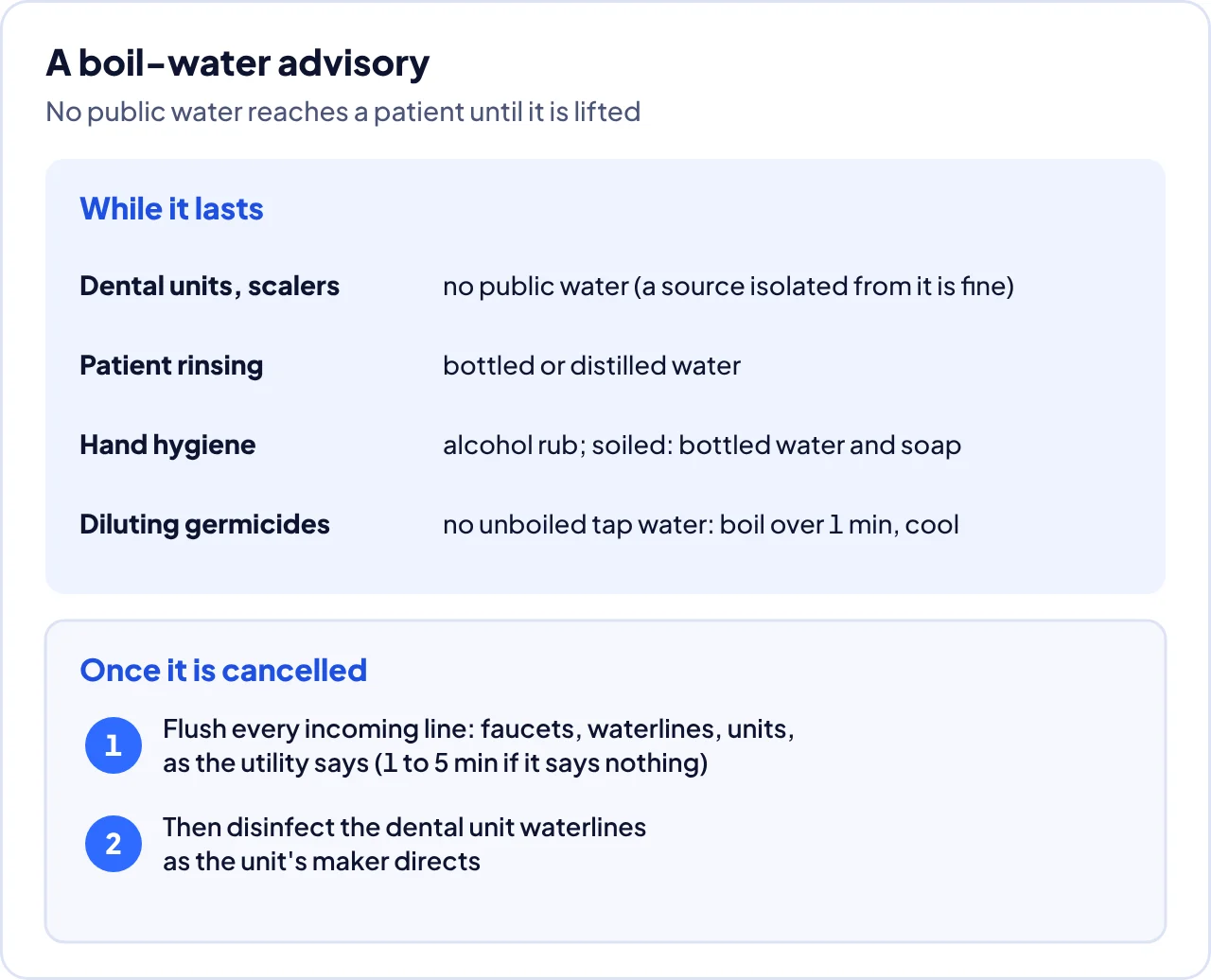
    A boil-water advisory: while it lasts, no public water through the units, bottled or distilled rinses, an alcohol rub, boiled water for dilutions; once cancelled, flush every line, then disinfect the waterlines
    • Boil-water: no public water to patients; no unboiled tap water for germicides (boil over 1 minute, cool); after, flush 1 to 5 minutes if the utility says nothing, then disinfect. Guide: Boil-water advisories

    The air

    • Respiratory hygiene (Standard Precautions since 2007): signs, tissues, a no-touch bin, hand hygiene by the waiting room, a mask for anyone coughing, a seat apart. Guide: Respiratory hygiene and cough etiquette
    • Preprocedural rinse lowers microbes in aerosols (most useful with a prophy cup or ultrasonic scaler); no recommendation to prevent infection. Guide: Aerosols and spatter
    • Saliva ejector: a lip seal, tubing above the mouth or HVE at the same time can send the line's contents back into the mouth; don't ask patients to close on the tip. Guide: Saliva ejectors and backflow
    TB statusInfectious?What the office does
    Latent (positive skin test, no symptoms)noroutine care, standard precautions Guide: Tuberculosis in the dental office
    Active or suspected (cough, night sweats, weight loss)yesmask, isolate, refer; defer elective care Guide: Tuberculosis in the dental office
    Urgent care neededyesairborne infection isolation, fit-tested N95s Guide: Tuberculosis in the dental office
    • Staff: screened at hire (risk assessment, symptoms, IGRA or skin test), no routine retesting since 2019; a cough over 3 weeks, evaluated and off work until shown noninfectious. Guide: Tuberculosis in the dental office

    The laboratory and radiography

    • Impressions and prostheses: clean, disinfect (tuberculocidal), rinse, as soon as they leave the mouth; write the disinfectant and time on the slip. Guide: Impressions, prostheses and the laboratory
    • Returned work: documented and in a tamper-evident container, or the office disinfects it. Guide: Impressions, prostheses and the laboratory
    • Digital sensors are semicritical: FDA-cleared barrier, then intermediate-level disinfection after each patient (barriers failed 44%, 6% with a finger cot). Guide: Radiography

    Who regulates what

    • CDC recommends ("not a regulatory agency"); OSHA enforces worker safety; HHS enforces HIPAA. Guide: Who regulates what
    • EPA registers surface disinfectants (FIFRA): follow the label's dilution and contact time; FDA clears sterilizers, sterilants and gloves. Guide: Who regulates what
    • CDC rank IC = required by federal or state regulation; a state OSHA plan is at least as effective as federal. Guide: Who regulates what

    OSHA

    • Exposure determination by job classification and task, without regard to PPE; the plan accessible to employees. Guide: The exposure determination and the written plan
    • Bloodborne pathogens training at assignment, then within one year; paid time, no cost, live questions. Guide: Bloodborne pathogens training and its records
    • Training records 3 years; medical records employment plus 30 years. Guide: Bloodborne pathogens training and its records
    • No eating, drinking, cosmetics, lip balm or contact lenses where exposure is likely. Guide: Rules of the work area: food, labels and laundry
    • Biohazard labels fluorescent orange or orange-red; red bags may substitute. Guide: Rules of the work area: food, labels and laundry
    • Hazard communication: written program and chemical list; an SDS for each chemical, reachable every shift. Guide: Hazard communication: the written program and safety data sheets
    • SDS: 16 sections; 2 hazards, 4 first aid, 7 handling and storage, 8 exposure controls and PPE. Guide: Hazard communication: the written program and safety data sheets
    • Hazard communication training at assignment and with each new hazard, not yearly. Guide: Hazard communication: the written program and safety data sheets
    • Every container labeled; exempt only the filler's own immediate-use container; eight pictograms, red frame. Guide: Labels and secondary containers
    • Respirators: written program, medical evaluation, fit test before use and annually. Guide: Respirators, the General Duty Clause and an employee's rights
    • General Duty Clause for hazards without a standard; poster posted; retaliation complaint within 30 days. Guide: Respirators, the General Duty Clause and an employee's rights

    HIPAA

    • Covered entity: a provider who sends health information electronically in a covered transaction. Guide: Who HIPAA covers: covered entities, business associates, the workforce
    • Business associates (billing, IT) sign a written agreement; providers receiving PHI for treatment don't. Guide: Who HIPAA covers: covered entities, business associates, the workforce
    • Treatment, payment, operations: no authorization; minimum necessary, except disclosures to a provider for treatment. Guide: Uses and disclosures: treatment, payment, operations, and authorization
    • Marketing needs an authorization; it expires, and is revoked in writing. Guide: Uses and disclosures: treatment, payment, operations, and authorization
    • Notice at the first visit, a good faith effort at a written acknowledgment; privacy and security officials; HIPAA documentation 6 years. Guide: The notice, the privacy official and training
    • Security Rule: risk analysis first; unique user IDs required; addressable = do it, or document why not and use a reasonable equivalent. Guide: The Security Rule's safeguards
    • Breach of unsecured PHI: patients within 60 days of discovery; media if more than 500 in a state. Guide: Breach notification
    • HHS: with the patients' notice if 500 or more; fewer than 500, within 60 days after the year ends. Guide: Breach notification

    The record

    • Whoever did the treatment writes it, at the time, initialed or signed; the dentist answers for the codes. Guide: What goes in the record, and what stays out
    • Money (ledgers, claims) and opinions stay out of the clinical record. Guide: What goes in the record, and what stays out
    • Correct by adding a dated, signed entry; the original stays readable; never erase, overwrite or backdate. Guide: Correcting an entry
    • A late entry carries the day it was written; an electronic record keeps an audit trail. Guide: Correcting an entry
    • Act on access within 30 days, amendments within 60 (one written extension each); HIPAA's paperwork six years; the chart's period from state law. Guide: Access, amendment and how long records are kept
    • Consent is the dentist's conversation; the signed form records it and is signed before treatment. Guide: Consent and refusal on paper
    • Not once nitrous oxide or heavy sedation has started: such consent may be invalid. Guide: Consent and refusal on paper
    • Refusal: chart the discussion, the reasons and the patient's understanding, signed or not; raise it again later. Guide: Consent and refusal on paper
    • After an error: disclose, explain, apologize, investigate, fix the system; disclosure goes with fewer suits. Guide: When something goes wrong: disclosure and incident handling

    Quality and safety

    TermMeaning
    Near missno injury, only by chance or a timely catch; report it Guide: Errors are systems problems: the Swiss cheese model
    Adverse eventharm from care; not by itself an error Guide: Errors are systems problems: the Swiss cheese model
    Sentinel eventdeath or serious harm, e.g., the wrong tooth; wrong-site = a never event Guide: Errors are systems problems: the Swiss cheese model
    Active vs latentthe act at the chair vs design and organization behind it Guide: Errors are systems problems: the Swiss cheese model
    Slip vs mistakelapse under distraction (redesign, checklists) vs wrong choice (training) Guide: Errors are systems problems: the Swiss cheese model
    Just cultureerror: fix the system; shortcut: address it; reckless: sanction, harm or not Guide: A just culture and incident reporting
    RCA vs FMEAafter an event, its latent causes (fishbone) vs before, each step scored Guide: Root cause analysis and FMEA
    PDSAplan a small test, do, study the data, then adapt, adopt or abandon Guide: Plan-Do-Study-Act and chart audits
    Extraction checklistsign-in, time-out before the instrument touches the tooth, sign-out Guide: The right patient, the right tooth: checklists and time-outs

    Controlled substances (DEA)

    StepRule
    Registerone registration per location that keeps or gives the drugs; renewed every 36 months Guide: Controlled substances: registration, ordering and storage
    OrderSchedule II on Form 222 or its electronic equivalent Guide: Controlled substances: registration, ordering and storage
    StoreSchedules II to V in a securely locked, substantially constructed cabinet Guide: Controlled substances: registration, ordering and storage
    Recordskept 2 years; inventory every 2 years; Schedule II exact and filed apart Guide: Records, inventory, theft and loss
    Theft or losswritten notice within 1 business day; Form 106 within 45 days Guide: Records, inventory, theft and loss
    Disposeon site, reverse distributor or the DEA's help; Form 41, two witnesses Guide: Disposal and the PDMP
    Patients' leftoversthe office can't collect them: take-back; check the PDMP before an opioid Guide: Disposal and the PDMP

    The team's hazards

    HazardLimitControl
    Posture78.4% of dental workers; neck and lower back firstloupes, indirect vision, posture, microbreaks Guide: Ergonomics
    Noise85 dBA (8 h): hearing program; 90 dBA for 8 h: limitbaseline audiogram within 6 months; shift = 10 dB at 2000, 3000, 4000 Hz Guide: Noise
    Nitrous oxide25 ppm over the time exposed (NIOSH); no OSHA limitactive scavenging, ventilation Guide: Nitrous oxide
    Mercury vapor0.05 mg/m³ (NIOSH); 0.1 mg/m³ ceiling (OSHA)tremor, insomnia, irritability Guide: Mercury
    Corrosives—eyewash within the work area Guide: Eyewash, radiation and sharps
    • The team's radiation protection is in Oral radiology; needlesticks and exposures are earlier in this sheet. Guide: Eyewash, radiation and sharps

    Dental benefits

    PlanHow it pays
    PPOset fees in the network (86% of plans, 2022); a smaller benefit out of network Guide: Plan types and how each pays
    EPOnetwork only; nothing out of network Guide: Plan types and how each pays
    Capitation (DHMO)a fixed amount per assigned patient each month; the dentist carries the cost risk Guide: Plan types and how each pays
    Indemnitya percentage of charges, up to the insurer's customary fee Guide: Plan types and how each pays
    Direct reimbursementa share of dollars spent, any dentist; the ADA's preferred method Guide: Plan types and how each pays
    Discount plannot insurance: the patient pays the discounted fee, no claim Guide: Plan types and how each pays
    • Typical design: 100% preventive and diagnostic, 80% basic, 50% major; $50 deductible; annual maximum $1,000 or $1,500. Guide: Deductibles, coinsurance and maximums
    • In network, plan + patient = the allowed fee (the rest written off); out of network, plan + patient = the full fee. Guide: Deductibles, coinsurance and maximums
    • Predetermination is an estimate, not a guarantee: eligibility and the remaining maximum are checked again. Guide: Predetermination and the explanation of benefits
    • Not covered (excluded) is not the same as bundled, downcoded or an alternate benefit; 42 states bar capping a non-covered fee. Guide: Predetermination and the explanation of benefits
    • Primary plan: own before dependent; children by the birthday rule (month and day; a court decree first); active job before COBRA or retiree; else the longer coverage. Guide: Coordination of benefits
    • Write off only after all plans have paid; the full fee on every claim. Guide: Coordination of benefits
    • LEAT pays the cheapest alternative; downcoding pays a cheaper code (composite paid as amalgam); bundling combines procedures. Code what you did. Guide: When the plan pays less: alternate benefits, downcoding and bundling
    • Appeal in writing, labeled "appeal", with radiographs, charting and a narrative; some plans allow six months. Guide: Appeals and assignment of benefits
    • Code 5.B: waiving the copay unseen by the plan is overbilling; one full fee for all payers; true dates and procedures. Guide: Honest claims
    • Medicaid and CHIP must cover children's dental (EPSDT); adults are the state's choice; Medicaid's payment is payment in full. Guide: Medicaid, CHIP and Medicare
    • Medicare excludes routine dental care; it pays when dental care is integral to a covered treatment (valve replacement, transplant, head and neck cancer). Guide: Medicaid, CHIP and Medicare
    • NPI, 10 digits: Type 1 the individual dentist (only one, never changes); Type 2 the organization (may hold several); not a license or a promise of payment. Guide: Who and what a claim names: the NPI and the CDT Code
    • CDT Code: the HIPAA standard code set for procedures on claims; "by report" codes carry a narrative. Guide: Who and what a claim names: the NPI and the CDT Code
    • Fees set alone: agreeing fees with competitors (raise, hold, cap) is per se illegal price fixing, and a joint refusal of a plan may be per se unlawful too; plan by production, collections, overhead against revenue and the break-even point. Guide: Setting fees and reading the practice's numbers

    The team

    • Employee or contractor: the right to control how the work is done (behavioral, financial, relationship), not the label. Guide: Employee or independent contractor
    • Before an offer: no medical questions or exam; ask whether and how the applicant can do the job; protected age is 40 or older. Guide: Hiring within the law
    • Accommodate a disability unless undue hardship; never required to remove an essential function; the employer picks among effective options. Guide: Reasonable accommodation
    • Never punish an EEO complaint or an accommodation request; overtime is time and one-half past 40 hours in each workweek, no averaging. Guide: Retaliation and overtime
    SupervisionDentist
    Personaloperating; the assistant aids at the same time Guide: Levels of supervision
    Directin the office; diagnoses, authorizes, checks before dismissal Guide: Levels of supervision
    Indirectin the office; authorizes and stays Guide: Levels of supervision
    Generalmay be away; prior knowledge and consent Guide: Levels of supervision
    • The final diagnosis and treatment plan are never delegated; an assistant's polish excludes calculus removal; the dentist answers for every delegated task. Guide: What may be delegated
    • Dental therapists: a narrower scope (caries prevention, direct restorations), set by state law; first CODA-accredited program in 2020. Guide: What may be delegated
    • Laboratory work: a written work order; Minnesota keeps the dentist's duplicate 2 years. Guide: What may be delegated

    Emergencies and continuity

    • Emergency action plan (29 CFR 1910.38): written and kept at work, or told orally with 10 or fewer employees. Guide: The emergency action plan
    • Minimum: report, evacuate, critical operations, rescue duties, account for everyone, a contact person; reviewed at hiring, when duties change, when the plan changes. Guide: The emergency action plan
    • BLS refreshers at least every two years (generally annually) and in-office drills; equipment checked on a schedule. Guide: Ready for a medical emergency
    • HIPAA contingency plan: backup, disaster recovery and emergency mode required; testing addressable; keep a copy off site. Guide: Backups and business continuity
    • Dental comparison is one of three primary identifiers with fingerprints and DNA; records may go to a medical examiner. Guide: Identifying the dead

    Technology

    Code or standardCarries
    CDTprocedures, for claims; no diagnosis Guide: Codes in the record: procedures and diagnoses
    SNODENT (aligned to SNOMED CT), DDS/SNODDSdental diagnoses and findings Guide: Codes in the record: procedures and diagnoses
    ICD-10-CMmedical diagnoses; little dental detail Guide: Codes in the record: procedures and diagnoses
    DICOMimages Guide: Exchanging records: interoperability standards
    HL7 v2 / CDA / FHIRmessages / documents / discrete data (medications, allergies) Guide: Exchanging records: interoperability standards
    X12 837the HIPAA dental claim Guide: Exchanging records: interoperability standards
    • Data quality: accurate (not wrong), complete (not missing), timely (not late); validate by reading a random sample of charts against the coded entries. Guide: Data quality: accurate, complete, timely
    • Ransomware: phishing is a common way in; train, multi-factor sign-in, encrypt, back up off site (about 1 in 5 restored from backups). Guide: Cybersecurity and ransomware
    • Teledentistry: the in-person standard; records enough to diagnose are the dentist's legal duty; a new patient's dentist licensed where the patient receives the services. Guide: Teledentistry in the practice
    • Store and forward = asynchronous; live video = synchronous; low sensitivity (as low as 18.75%) means a negative remote finding may not rule out. Guide: Teledentistry in the practice
    • AI supplements the dentist's judgment, never replaces it: the dentist supervises, decides and documents. Guide: AI tools: what the dentist still decides
    • AI accuracy: prevalence down → PPV down (sensitivity and specificity stay); a lower threshold → sensitivity up, specificity down. Guide: Judging an AI tool's accuracy
    • Scored on training data = data snooping; internal validation stays home; external validation on independent data travels; STARD-AI for accuracy studies. Guide: The evidence behind an AI tool

    DentPrep · INBDE Infection Control and Practice Management cheat sheet · dentprep.me/inbde

    Practice infection control and practice management the exam's way.

    Your free account opens 100 INBDE questions with every option explained, and every subject's notes and cheat sheet.

    Start freeFree account · No card

    3 practice questions

    Three questions from the infection control and practice management bank, each with its answer, why every other option is wrong, and its sources.

    Question 1 of 3

    How long does OSHA require each bloodborne pathogens training record to be kept?

    1. A1 year from the date of the training
    2. B3 years from the date of the training
    3. C5 years from the date of the training
    4. DThe duration of employment plus 30 years
    Show the answer

    Answer B3 years from the date of the training

    OSHA requires bloodborne pathogens training records to be kept for 3 years from the date on which the training occurred.

    Why the others are wrong

    • AOne year is the interval between training sessions, not how long their records are kept.
    • CFive years is not the standard's period; training records are kept 3 years.
    • DEmployment plus 30 years is for each exposed employee's confidential medical record.

    The rule (OSHA 1910.1030(h)(2)): training records include "The dates of the training sessions", the contents or a summary, "The names and qualifications of persons conducting the training", and the names and job titles of those attending. "Training records shall be maintained for 3 years from the date on which the training occurred."

    OSHA record Kept for
    Bloodborne pathogens training records 3 years from the training
    Each exposed employee's medical record the duration of employment plus 30 years

    Applied to the inspection: the office shows each session's record for the last 3 years: date, content, trainer and attendees. An employee's hepatitis B vaccination and exposure follow-up sit in the separate, confidential medical record.

    Trap: mixing the two clocks. Thirty years is for medical records, which outlast employment; training records are kept 3 years.

    The point to rememberTraining records 3 years; medical records employment plus 30 years.

    Sources (1)
    1. Occupational Safety and Health Administration. Bloodborne pathogens. 29 CFR 1910.1030, (h)(1)(iv), (h)(2)
    Question 2 of 3

    Half a lidocaine cartridge remains in the syringe after one patient's injection. May the rest be used for the next patient?

    1. AYes, after wiping the diaphragm with alcohol
    2. BNo; discard the cartridge, reuse the syringe as is
    3. CNo; discard cartridge and needle, heat-sterilize the syringe
    4. DYes, with a new needle
    Show the answer

    Answer CNo; discard cartridge and needle, heat-sterilize the syringe

    The CDC's note on local anesthesia: do not use the needle or anesthetic cartridge for more than one patient, and clean and heat-sterilize the dental cartridge syringe before use on another patient.

    Why the others are wrong

    • AWiping the diaphragm does not make a used cartridge safe for another patient.
    • BThe syringe is reusable only after cleaning and heat sterilization.
    • DA cartridge is a single-patient container; leftover contents are never used for another patient.

    The rule (CDC 2016): "When using a dental cartridge syringe to administer local anesthesia, do not use the needle or anesthetic cartridge for more than one patient. Ensure that the dental cartridge syringe is appropriately cleaned and heat sterilized before use on another patient."

    Where it fits: "DHCP most frequently handle parenteral medications when administering local anesthesia, during which needles and cartridges containing local anesthetics are used for one patient only." Like a single-dose vial, the cartridge's leftover is discarded: "Do not combine the leftover contents of single-use vials for later use."

    Item Between patients
    Needle discarded into a sharps container
    Cartridge, partly used discarded, never used for another
    Cartridge syringe cleaned and heat-sterilized

    Applied to the cartridge: the half-full cartridge and the needle are discarded; the next patient gets a new cartridge, a new needle and a sterilized syringe.

    Trap: seeing the cartridge as untouched because the needle took the contact. Aspiration and backflow can contaminate it; it is single-patient.

    The point to rememberAnesthetic cartridge and needle: one patient; the cartridge syringe cleaned and heat-sterilized.

    Sources (1)
    1. Centers for Disease Control and Prevention. Summary of infection prevention practices in dental settings: basic expectations for safe care. Atlanta: CDC; 2016, Safe injection practices

    Question 3 of 3

    A heat-sensitive critical item is sterilized by immersion in an FDA-cleared liquid chemical sterilant. Which statement about it is correct?

    1. ARinsed with sterile water and used at once, never stored as sterile
    2. BWrapped after rinsing and stored as sterile
    3. CSterile after 12 to 90 minutes of immersion
    4. DConfirmed by a weekly Geobacillus stearothermophilus spore test
    Show the answer

    Answer ARinsed with sterile water and used at once, never stored as sterile

    The CDC says items from a liquid chemical sterilant must be rinsed with sterile water, handled with sterile gloves and delivered aseptically; if stored before use, the item should not be considered sterile.

    Why the others are wrong

    • BLiquid-sterilized items cannot be wrapped and kept sterile; event-related shelf life applies to wrapped packs that came out of a sterilizer intact.
    • CTwelve to 90 minutes gives only high-level disinfection; sterilization can need about 12 hours of complete immersion.
    • DThe CDC says the sterilization process with liquid chemical sterilants cannot be verified with biological indicators.

    The rule (CDC 2003): liquid chemical sterilants "can require approximately 12 hours of complete immersion" and so "are almost never used to sterilize instruments". Items "need to be 1) rinsed with sterile water after removal to remove toxic or irritating residues; 2) handled using sterile gloves and dried with sterile towels; and 3) delivered to the point of use in an aseptic manner. If stored before use, the instrument should not be considered sterile". And "the sterilization process with liquid chemical sterilants cannot be verified with biological indicators".

    Immersion (CDC 2003; the product's label sets the exact time) Achieves
    12–90 minutes high-level disinfection (semicritical items)
    about 12 hours (3 to 12 hours by product, CDC 2008) sterilization

    Applied to the question: rinse with sterile water, use at once, never store as sterile.

    Trap: treating a soaked instrument like a wrapped, autoclaved pack.

    The point to rememberA liquid sterilant takes hours, can't be spore-tested, and its items can't be stored sterile.

    Sources (1)
    1. Kohn WG, Collins AS, Cleveland JL, Harte JA, Eklund KJ, Malvitz DM. Guidelines for infection control in dental health-care settings, 2003. MMWR Recomm Rep. 2003;52(RR-17), Sterilization of unwrapped instruments; Other sterilization methods

    Take the free 20-question test →

    What the full guide covers

    The Infection Control and Practice Management guide runs to about 28,000 words in 8 parts:

    1. Standard precautions, hand hygiene, safe injections, waste and the team's health
    2. PPE, bloodborne pathogens, sharps and exposures
    3. Instrument processing and sterilization
    4. Surfaces, waterlines, aerosols and the laboratory
    5. OSHA, HIPAA and who regulates what
    6. The record, risk, quality, drugs in the office and the team's hazards
    7. Dental benefits, the team and emergency preparedness
    8. Technology: the record's data, teledentistry and AI

    The full notes and their PDF are free on a DentPrep account, beside the question bank.

    More INBDE subjects

    Practice and profession

    All 23 subjects →

    Free on your account

    100 INBDE questions, free.

    Every option explained, and every note, cheat sheet and PDF. Your free account never ends.

    One plan for all of it: $49 a month, $129 for three months, or $349 a year.

    Start freeFree account · No cardSee pricing
    What else your free account opens
    • Interviews5 scored answers, 1 mock interview with its report, and 2 Casper scenarios
    • TOEFLAll 20 lessons, one practice set of each Reading and Listening task, and 2 scored speaking or writing tasks
    • Application reviewYour first statement or resume review: the verdict, the summary, the strengths and the 2 most serious suggestions
    • Dental schoolFree: your lectures, summaries, questions and flashcards, 10 drafts and 10 summaries a day
    • School guidesAll 113, no account needed
    20 INBDE questions, free.Take the test